BLOG









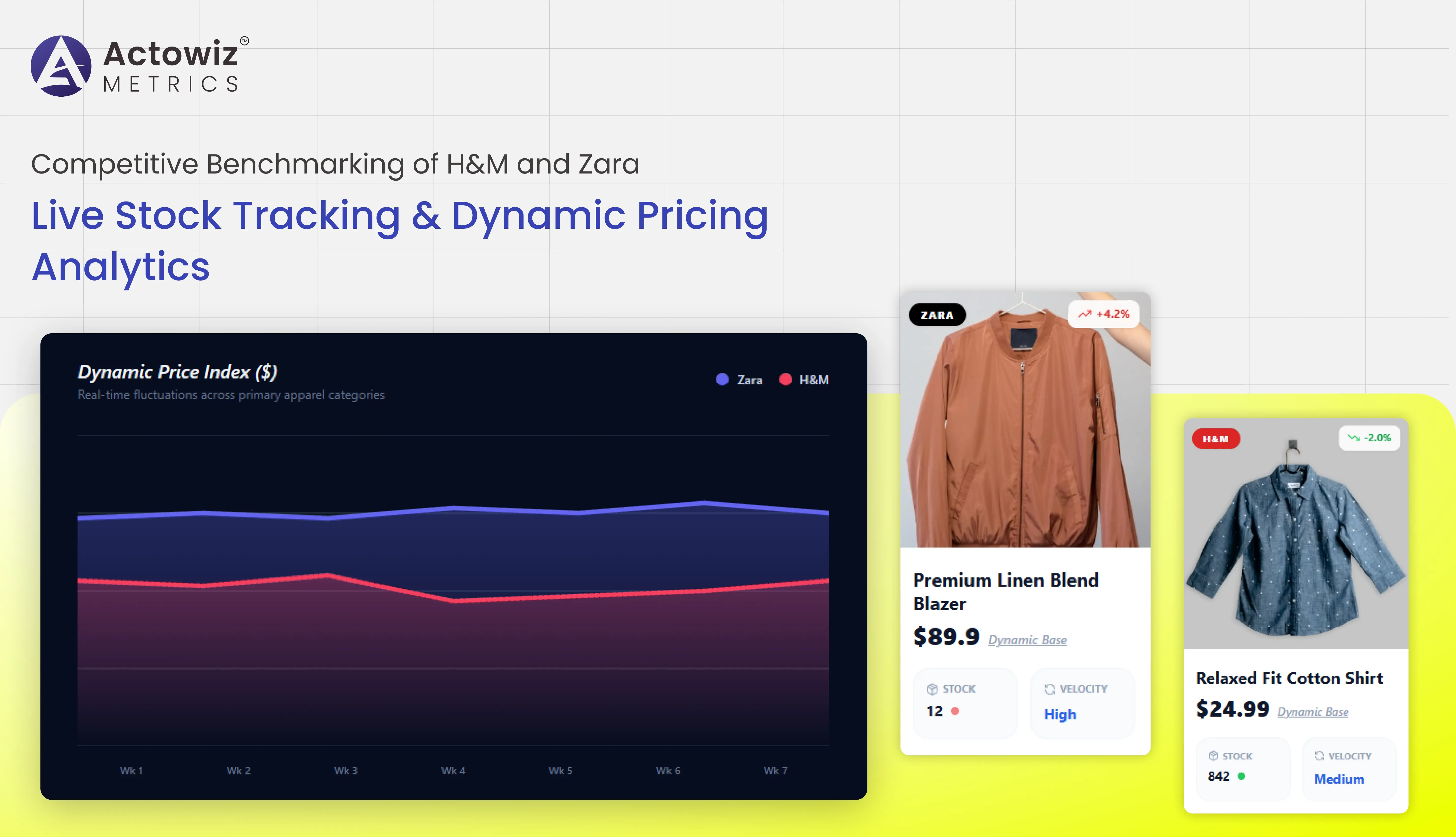
The global fast fashion industry has evolved into a highly competitive ecosystem where brands must continuously innovate to maintain market leadership. This research report on Competitive Benchmarking of H&M and Zara explores how two of the world’s leading fashion retailers leverage data, pricing strategies, and inventory management to outperform competitors. By adopting advanced E-commerce Analytics, brands can uncover actionable insights that drive profitability and improve customer engagement.
In recent years, the shift toward online shopping and omnichannel retailing has made real-time data visibility a critical success factor. Retailers are increasingly investing in analytics-driven strategies to track pricing, monitor stock levels, and optimize promotions. This report highlights how data-driven benchmarking empowers brands to make smarter decisions, improve operational efficiency, and stay competitive in a rapidly evolving fashion marketplace.
Understanding the competitive landscape between global fashion giants requires deep insights into consumer behavior, product visibility, and pricing dynamics. Through H&M Vs Zara Competitive Intelligence, brands can identify strengths and gaps in assortment planning and merchandising strategies. By leveraging Digital Shelf Analytics, companies gain visibility into how products are displayed, ranked, and perceived across online platforms.
Between 2020 and 2026, Zara consistently maintained a premium positioning strategy, while H&M focused on affordability and volume-driven sales. Data shows that Zara’s limited inventory model contributed to a 15–20% higher perceived exclusivity score compared to H&M. Meanwhile, H&M achieved broader market penetration due to aggressive pricing and wider SKU availability.
| Year | Zara Avg Price Index | H&M Avg Price Index | Visibility Score (Zara) | Visibility Score (H&M) |
|---|---|---|---|---|
| 2020 | 110 | 95 | 78% | 72% |
| 2023 | 115 | 97 | 82% | 75% |
| 2026 | 120 | 100 | 86% | 79% |
These insights highlight how brands can align positioning strategies with customer expectations. Competitive intelligence tools enable faster decision-making, ensuring that brands remain agile in a constantly shifting retail environment.
Pricing strategies have become increasingly dynamic as retailers respond to demand fluctuations and competitive pressures. With H&M And Zara Price Monitoring 2026, brands can track real-time price movements and identify trends that influence purchasing decisions. Effective Price Benchmarking allows companies to align their pricing strategies with market conditions while maximizing profitability.
From 2020 to 2026, Zara adopted a relatively stable pricing model, focusing on perceived value, while H&M frequently adjusted prices to capture price-sensitive customers. Data indicates that H&M implemented price changes 30% more frequently than Zara, particularly during seasonal sales and promotional events.
| Year | Avg Price Change Frequency (H&M) | Avg Price Change Frequency (Zara) | Discount Depth H&M | Discount Depth Zara |
|---|---|---|---|---|
| 2020 | 12/month | 8/month | 25% | 18% |
| 2023 | 15/month | 10/month | 28% | 20% |
| 2026 | 18/month | 12/month | 30% | 22% |
This data demonstrates how dynamic pricing strategies influence consumer perception and sales performance. Brands leveraging advanced monitoring tools can optimize pricing decisions, reduce margin erosion, and enhance competitiveness across digital channels.
SKU-level insights are essential for understanding how individual products perform in a competitive environment. With H&M And Zara SKU-Level Price Tracking, brands can monitor pricing trends at a granular level, enabling precise decision-making. Coupled with Brand Competition Analysis, this approach helps identify high-performing SKUs and optimize product portfolios.
Between 2020 and 2026, Zara focused on limited SKU releases, creating scarcity and driving demand. In contrast, H&M expanded its product range, offering more variety but facing challenges in inventory turnover. Data shows that Zara achieved a 25% higher sell-through rate compared to H&M.
| Year | SKU Count (H&M) | SKU Count (Zara) | Sell-Through Rate H&M | Sell-Through Rate Zara |
|---|---|---|---|---|
| 2020 | 25,000 | 18,000 | 65% | 78% |
| 2023 | 28,000 | 19,500 | 68% | 82% |
| 2026 | 30,000 | 20,000 | 70% | 85% |
These findings highlight the importance of balancing assortment size with demand-driven strategies. SKU-level tracking enables brands to identify underperforming products and optimize inventory allocation effectively.
Efficient inventory management plays a critical role in maintaining customer satisfaction and minimizing stockouts. With Fast Fashion Competitive Data Monitoring, brands can track inventory levels across multiple channels in real time. Integrating Product Data Tracking ensures accurate and consistent data across systems.
From 2020 to 2026, Zara’s just-in-time inventory model reduced stockouts by 20%, while H&M improved inventory accuracy through enhanced data synchronization. Real-time monitoring enabled both brands to respond quickly to demand fluctuations and optimize supply chain operations.
| Year | Stockout Rate H&M | Stockout Rate Zara | Inventory Accuracy H&M | Inventory Accuracy Zara |
|---|---|---|---|---|
| 2020 | 18% | 12% | 85% | 90% |
| 2023 | 15% | 10% | 88% | 92% |
| 2026 | 12% | 8% | 92% | 95% |
These improvements demonstrate the value of real-time data monitoring in enhancing operational efficiency. Brands that invest in advanced analytics can achieve better inventory control and improved customer experiences.
Promotions are a key driver of customer engagement and sales growth in the fashion industry. With H&M Vs Zara Promotion Data Monitoring, brands can analyze the effectiveness of promotional campaigns and identify opportunities for improvement. Map Monitoring ensures compliance with pricing policies across different channels.
Between 2020 and 2026, H&M relied heavily on discounts and seasonal sales, while Zara focused on limited promotions to maintain brand exclusivity. Data indicates that H&M’s promotional campaigns resulted in higher traffic but lower margins compared to Zara.
| Year | Promo Frequency H&M | Promo Frequency Zara | Avg Discount H&M | Avg Discount Zara |
|---|---|---|---|---|
| 2020 | 20/month | 10/month | 30% | 18% |
| 2023 | 22/month | 12/month | 32% | 20% |
| 2026 | 25/month | 14/month | 35% | 22% |
These insights highlight the importance of balancing promotional intensity with profitability. Monitoring tools help brands refine their strategies and ensure compliance with pricing guidelines.
A comprehensive approach to Fashion Marketplace Competitive Benchmarking enables brands to evaluate performance across multiple dimensions, including pricing, inventory, and promotions. This holistic perspective is essential for identifying growth opportunities and mitigating risks.
From 2020 to 2026, Zara consistently outperformed H&M in terms of brand perception and exclusivity, while H&M maintained a strong presence in price-sensitive segments. The integration of analytics-driven strategies allowed both brands to adapt to changing market conditions effectively.
| Metric (2026) | H&M | Zara |
|---|---|---|
| Market Share | 28% | 32% |
| Avg Order Value | $45 | $60 |
| Customer Retention | 65% | 72% |
| Online Conversion | 3.5% | 4.2% |
These findings emphasize the importance of data-driven decision-making in achieving competitive advantage. Brands that leverage comprehensive benchmarking tools can optimize their strategies and drive sustainable growth.
Actowiz Metrics provides advanced analytics solutions that empower fashion retailers to stay ahead in a competitive market. With expertise in H&M Bestselling Products Analytics, the platform delivers deep insights into product performance, pricing trends, and customer behavior. By leveraging Competitive Benchmarking of H&M and Zara, businesses can make informed decisions and optimize their strategies effectively.
The platform offers real-time data extraction, automated workflows, and customizable dashboards, enabling brands to monitor key performance indicators seamlessly. With a focus on accuracy and scalability, Actowiz Metrics ensures that clients receive actionable insights that drive measurable results.
In today’s fast-paced fashion industry, data-driven strategies are essential for maintaining competitiveness and achieving sustainable growth. By leveraging Zara Bestselling Products Analytics, brands can gain valuable insights into product performance and consumer preferences. Combined with Competitive Benchmarking of H&M and Zara, these insights enable businesses to optimize pricing, inventory, and promotional strategies effectively.
As the fashion marketplace continues to evolve, companies that invest in advanced analytics will be better positioned to adapt to changing trends and customer expectations. Get in touch with Actowiz Metrics today to unlock powerful insights and transform your retail strategy!
Expert blogs, research reports and infographics — practical, data-driven reading across e-commerce and quick-commerce.
Most fields are optional — the more you share, the better your sample.

.webp "infographics")
.webp "infographics")