BLOG









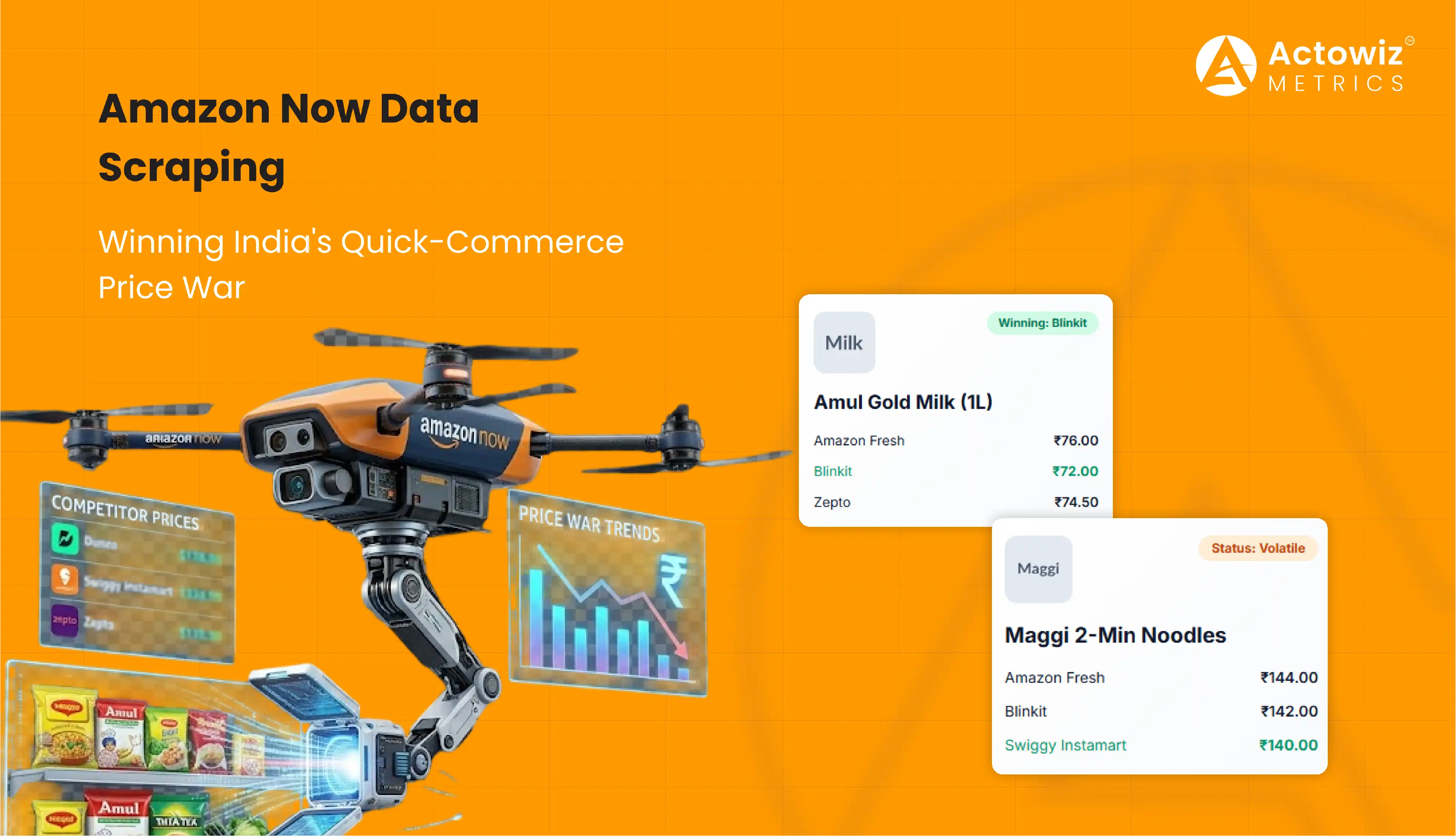
India's quick-commerce market has turned into an open price war, and Amazon Now has walked straight into the center of it. Launched in June 2025 and now expanding from a handful of metros toward hundreds of cities, Amazon's minutes-delivery service is competing head-to-head with Blinkit, Zepto, Swiggy Instamart, Flipkart Minutes, BigBasket Now, and JioMart for the same shoppers, the same baskets, and the same few minutes of decision time. In this environment, the same bottle of cola or pack of noodles can carry a different price on every app, in every locality, at every hour of the day.
For brands, this fragmentation is both a threat and an opportunity. A shopper comparing prices across five apps will notice a two-rupee gap, and a stockout on one platform hands the sale to another instantly. Winning here is impossible without continuous, cross-platform visibility. Amazon Now data scraping gives brands exactly that: a real-time, pincode-level view of how Amazon Now is priced, stocked, and promoted relative to every rival. This research report, built around live quick-commerce data patterns, shows what to monitor, what the data reveals, and how Actowiz Metrics turns the price war into a measurable advantage.
Amazon Now fulfills orders from hyperlocal dark stores rather than distant warehouses, promising delivery in roughly ten to fifteen minutes. What began in the largest metros—Delhi-NCR, Mumbai, Bengaluru, Chennai, Hyderabad, Kolkata, and Pune—is now spreading into high-growth Tier 2 and Tier 3 cities such as Ahmedabad, Kochi, Jaipur, Lucknow, Chandigarh, Kanpur, and Visakhapatnam. Each new city brings ultra-fast delivery to millions of new customers, and it also brings Amazon Now into direct contact with established rivals that already operate dense dark-store networks there.
This expansion is what turns ordinary pricing into a price war. When six or seven apps offer the same grocery item within minutes, price, availability, and promotion become the primary levers of choice. Amazon Now's aggressive growth—supported by micro-fulfillment centers and larger urban fulfillment centers that widen its assortment—means the competitive picture shifts constantly, city by city. Brands that cannot see this picture in real time are, in effect, competing blind in the fastest-growing corner of Indian retail.
The clearest symptom of the price war is that a single product rarely shares one price. The comparison below, reflecting live quick-commerce pricing, shows how everyday items are priced across the major platforms. The lowest price for each product is highlighted—and it does not always belong to the same platform, which is precisely why single-platform monitoring is misleading.
| Product | Amazon Now | Blinkit | Zepto | Instamart | Flipkart Min. | BigBasket |
|---|---|---|---|---|---|---|
| Coca-Cola 2L | ₹94 | ₹96 | ₹95 | ₹98 | ₹93 | ₹97 |
| Maggi 12-Pack | ₹164 | ₹168 | ₹166 | Out of Stock | ₹169 | ₹163 |
| Surf Excel | ₹479 | ₹485 | ₹482 | — | — | — |
Price is only one dimension. Stock availability and promotional intensity decide who actually captures the sale once a shopper opens an app. The platform snapshot below, drawn from a live quick-commerce dashboard view, summarizes where each player stands on availability and active promotions.
| Platform | Stock Availability | Active Promos | Signal |
|---|---|---|---|
| Amazon Now | 94.2% | 620 | Highest availability |
| BigBasket Now | 93.1% | 470 | Strong stock, fewer promos |
| Blinkit | 91.6% | 748 | Most aggressive promotions |
| Zepto | 90.8% | 710 | Promo-heavy challenger |
| Swiggy Instamart | 88.9% | 684 | Risk: 84 priority SKUs out of stock |
| Flipkart Minutes | 87.4% | 510 | Lowest basket price |
Beneath the platform averages sits a hyperlocal reality: prices, availability, and delivery speed shift from metro to Tier 2 to Tier 3 city, and from pincode to pincode. The illustrative view below shows how a single SKU can behave across Amazon Now's expanding footprint—cheaper and faster in dense metros, pricier and slower in newer markets.
| City | Tier | Coca-Cola 2L | Availability | Delivery ETA |
|---|---|---|---|---|
| Delhi-NCR | Metro | ₹93 | In Stock | 10 min |
| Mumbai | Metro | ₹94 | In Stock | 12 min |
| Bengaluru | Metro | ₹94 | In Stock | 11 min |
| Ahmedabad | Tier 2 | ₹96 | Low Stock | 16 min |
| Jaipur | Tier 2 | ₹97 | In Stock | 18 min |
| Visakhapatnam | Tier 3 | ₹98 | Limited | 22 min |
Winning in quick commerce requires continuous monitoring across six dimensions. Each maps directly to a decision a brand or category team makes every day, and together they define a complete Amazon Now monitoring program.
Raw quick-commerce data is only useful when it becomes decision-ready intelligence. Actowiz Metrics helps brands monitor real-time marketplace data to optimize pricing and stay ahead of competitors, through five connected capabilities.
Continuous capture of prices and discounts across Amazon Now and every rival, so pricing teams see undercutting the moment it happens and can respond with confidence rather than delay. In a market where a two-rupee gap can move a shopper to another app, the difference between hourly and daily visibility is the difference between defending a sale and losing it. Automated tracking removes the lag that manual checks introduce and keeps every decision grounded in the current price, not yesterday's.
Product-level tracking of availability, listing health, and rank across platforms, ensuring every hero SKU stays visible, in stock, and competitively placed where it matters most. Because quick-commerce inventory turns over within hours, SKU-level signals catch problems—suppressed listings, sudden stockouts, slipping rank—before they quietly erode sales, giving brands time to act while the fix still matters.
Location-tagged data that reveals how price, stock, and delivery differ by pincode and city, turning Amazon Now's hyperlocal complexity into a clear, comparable map. As the service pushes into Tier 2 and Tier 3 markets, this granularity lets brands set locally intelligent prices and prioritize the neighborhoods where demand and margin are highest, rather than applying one blunt national strategy everywhere.
Side-by-side comparison across Blinkit, Zepto, Instamart, Flipkart Minutes, and BigBasket Now, showing exactly who wins on price, availability, and promotions in each market. Since the cheapest platform changes by product and locality, only a true cross-platform view answers the question that matters—am I winning the basket here, right now—and points to the specific lever that will change the outcome.
Trends, alerts, and dashboards that convert millions of data points into the handful of signals a team needs to act—stockout alerts, price gaps, and promotion shifts surfaced in real time.
The patterns in the data above translate into concrete, revenue-relevant signals that only continuous monitoring surfaces.
Quick commerce compresses the entire retail decision into a few minutes, and that compression changes what monitoring must deliver. On a traditional marketplace, a brand can review its prices once a day and lose very little. In a minutes-delivery price war, prices, promotions, and stock move continuously, and a shopper who opens an app makes an instant choice based on whatever is true at that second. A price cut a competitor made an hour ago, or a stockout that began this morning, is already shaping sales while a brand relying on periodic checks remains unaware.
This is why frequency is not a technical detail but a strategic one. The value of Amazon Now data scraping rises with how closely it tracks reality: near-real-time capture across platforms and pincodes lets a brand respond within the same window in which decisions are being made, rather than reacting after the opportunity has passed. Speed also compounds. A brand that consistently detects competitor stockouts, price moves, and promotion launches first can repeatedly capture demand that slower rivals never even see. In a market consolidating toward a few winners, that repeated edge—small on any single day—adds up to a decisive advantage over a season.
Actowiz Metrics specializes in turning the fast-moving, hyperlocal quick-commerce landscape into clean, structured datasets a team can act on. Rather than a fixed report, we build extraction pipelines around each client's catalog, competitive set, categories, and target cities or pincodes—so you monitor exactly the platforms and dark-store markets that matter to your business, at the frequency the price war demands.
Our Amazon Now solution captures pricing, discounts, availability, delivery ETAs, search rank, and assortment—each record tagged with its platform, city, and pincode and timestamped for accuracy—alongside cross-platform comparisons against Blinkit, Zepto, Swiggy Instamart, Flipkart Minutes, and BigBasket Now. Data is validated and delivered through scheduled feeds, APIs, or ready-to-use dashboards that flow straight into your pricing engine and BI tools. Because the pipelines are custom-built and scalable, they extend from a few pilot pincodes to nationwide coverage as your footprint grows.
India's quick-commerce price war will not slow down—if anything, Amazon Now's expansion into Tier 2 and Tier 3 cities will sharpen it. In a market where the cheapest price, the best availability, and the fastest delivery change by product, platform, and pincode, intuition is no substitute for data. Amazon Now data scraping replaces guesswork with a real-time, cross-platform, hyperlocal view of the battlefield—so brands can defend their shelf, win the basket, and grow faster than rivals still competing blind.
Ready to stay ahead of every price change? Partner with Actowiz Metrics for real-time Amazon Now data scraping and cross-platform quick-commerce intelligence built around your catalog and markets. Request a sample dataset or a scoping call today, and turn the price war into your advantage.
Expert blogs, research reports and infographics — practical, data-driven reading across e-commerce and quick-commerce.
Most fields are optional — the more you share, the better your sample.
.webp "infographics")
.webp "infographics")