BLOG


















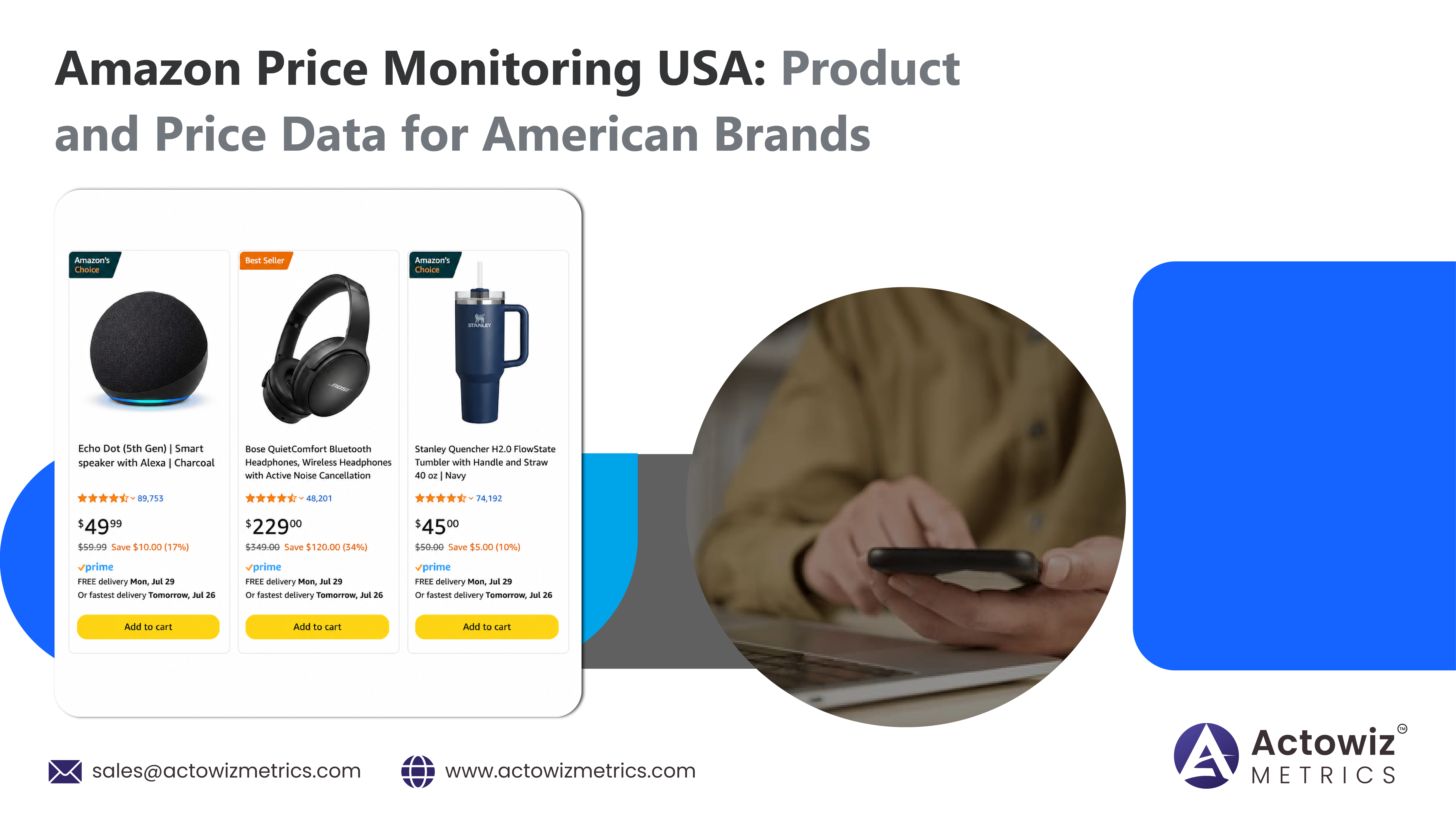
Amazon.com is the most competitive retail shelf in the world. Millions of sellers, algorithmic repricing, and a Buy Box that can change hands several times a day combine to create a marketplace where pricing is never settled. For American brands and sellers, the difference between growth and stagnation increasingly comes down to how quickly they can see and respond to what competitors are doing. Amazon price monitoring USA — the continuous, structured tracking of competitor prices and related signals — has become foundational rather than optional.
The stakes are high because Amazon rewards responsiveness. A product that loses the Buy Box loses the overwhelming majority of its sales for as long as it stays lost, and a price that sits above the market for a day quietly cedes volume that is hard to recover. Yet many brands still monitor competitors by hand, checking a handful of listings occasionally and hoping nothing important changed in between. This article explains why that approach fails on Amazon US, what a brand should actually track, and how structured price data turns a reactive scramble into a controlled, profitable strategy.
The argument here is not that brands should chase every price movement, which would be exhausting and often unprofitable. It is that they should be able to see movement clearly enough to choose which ones matter. Visibility is what makes selectivity possible; without it, a brand is not choosing its battles but simply missing them.
Three characteristics make Amazon.com harder to compete on than almost any other channel. The first is density: most products face many sellers, several of whom use automated repricing tools that adjust prices continuously in response to one another. The second is the Buy Box, which concentrates demand so heavily that winning or losing it is effectively binary for sales volume. The third is speed — the combination of density and automation means the competitive picture can change within minutes, not days.
Layered on top is scale. A brand with a few hundred SKUs, each facing several competitors, is tracking thousands of moving prices. Doing that manually is impossible, and doing it occasionally is close to useless, because the checks miss precisely the changes they were meant to catch. The market rewards brands that can see continuously and respond quickly, and it quietly penalises those that cannot.
Seasonality adds a further dimension. Major events such as Prime Day and the holiday period compress an entire quarter's competitive intensity into a few days, when prices move fastest and the cost of being slow is highest. Brands that enter those windows without real-time visibility are competing in the most consequential period of the year with the least information.
The penalty for slow response on Amazon is quiet and cumulative rather than dramatic. A competitor undercuts a product on a Tuesday; the brand notices the following week; in between, the Buy Box shifted, sales dipped, and the product's rank slipped slightly. None of these events announces itself, and the brand may attribute the softer week to seasonality. Repeated across dozens of products and dozens of weeks, this pattern amounts to a meaningful and entirely avoidable drag on performance.
Rank effects make the damage persist. Because sales velocity influences ranking and ranking influences visibility, a period of lost Buy Box or elevated pricing can depress a product's position well after the pricing issue is corrected. Recovering that position takes longer than losing it did, which is why speed of detection matters more on Amazon than on channels where visibility is less tightly coupled to recent sales.
Effective monitoring goes well beyond a competitor's headline price. The signals below work together, and tracking them as a set is what allows a brand to understand not just that it lost a sale but why.
| ASIN | Your Price | Lowest Competitor | Buy Box | Stock | Signal |
|---|---|---|---|---|---|
| B08N5WRWNW | $79.99 | $77.49 | Lost | In Stock | Undercut — review |
| B07QK1FZ2M | $129.00 | $131.50 | Won | In Stock | Leading |
| B09XYZ8LMN | $45.00 | $44.20 | Lost | Low Stock | Undercut + stock risk |
| B01ABC7DEF | $212.00 | Out of Stock | Won | In Stock | Rival out — push ads |
Illustrative sample — price, Buy Box, and stock read together turn raw data into a clear action per ASIN.
The purpose of monitoring is to change decisions, and the brands that benefit most define in advance what each signal should trigger. For fast-moving, lower-risk products, that often means automated repricing rules that adjust within guardrails the moment a competitor moves. For hero products and flagship items, it more often means an alert that prompts a human review, so judgement is applied before a headline price changes.
A margin floor is essential in either case. Automated responses without one risk a race to the bottom in which everyone loses, so the rule should be to stay competitive down to a defined limit and no further. Where a competitor prices below that floor, the right response is usually not to follow but to compete on other levers — content, reviews, advertising, or bundle value — which the same data helps identify.
It is also worth deciding in advance which products warrant aggressive defence and which do not. Not every SKU justifies matching a competitor's price; some are better protected through content, reviews, or bundling, and some are simply not worth winning at the price a rival is willing to accept. Making these choices deliberately, informed by data, is far better than making them accidentally through inattention.
Competitor stockouts deserve particular attention because they are the clearest short-term opportunity on Amazon. When a rival goes out of stock, demand that would have gone to them is briefly available, and a brand that detects this quickly can raise advertising and capture it. Brands relying on periodic checks usually discover the window after it has closed.
Manual monitoring breaks down on Amazon for reasons that are structural rather than a matter of diligence. It cannot cover enough listings frequently enough to catch changes that happen within hours. It struggles to match products accurately, so comparisons drift to the wrong competitor. It produces data that is stale by the time it is compiled. And it consumes the very hours that should be spent acting on the information.
The hidden cost is the decisions not made. Every undetected undercut is volume lost quietly; every missed competitor stockout is demand left on the table; every slow response during a peak event is disproportionately expensive. These losses rarely appear as a line item, which is why manual monitoring can feel adequate while steadily underperforming.
Price is where most brands start, but it rarely explains performance on its own. A product may be priced competitively and still underperform because its listing content is weaker, its review profile is thinner, or a competitor has recently improved theirs. Tracking ratings, review velocity, and emerging complaints alongside price reveals these dynamics and often points to fixes that are more durable than a price cut.
Listing health belongs in the same picture. Titles, images, and attributes determine whether a product surfaces for a search at all, so a content gap can suppress a well-priced product entirely. Monitoring these elements across a catalogue surfaces problems that would otherwise be invisible, and because they are fixable once and permanently, they often deliver better returns than the recurring cost of discounting.
Peak periods concentrate a quarter's competitive intensity into days, and they reward preparation more than reaction. The work that matters happens beforehand: establishing where competitors normally price so that event discounting can be judged against a real baseline, confirming that hero listings are complete and well stocked, and deciding in advance how far prices will be allowed to move and on which products.
During the event itself, the priority shifts to speed. With prices moving several times a day, monitoring frequency should rise, alerts should be routed to people who can act immediately, and pre-agreed rules should handle the routine cases so human attention goes to the exceptions. Brands that enter a peak with this structure in place spend the event executing; those that do not spend it improvising, usually a step behind.
Stock planning belongs in the same preparation. A peak event concentrates demand, and a hero product that sells out mid-event loses not only those orders but the rank momentum the event was meant to build. Watching availability as closely as price during these windows is what prevents a successful promotion from turning into an expensive stockout.
Afterwards, the same data becomes a learning asset. Reviewing how competitors priced, which of a brand's responses worked, and where visibility was won or lost turns each event into preparation for the next one. Few brands do this systematically, which is precisely why it compounds into an advantage for those that do.
Brands generally choose between building collection in-house and sourcing a managed feed. Building means maintaining infrastructure that must keep working as the marketplace evolves, solving product matching, and cleaning data continuously — an ongoing engineering commitment that competes with the commercial work a retail team should be doing. A managed service absorbs that burden and delivers validated, structured data through dashboards, scheduled reports, or an API.
Whichever route is chosen, the criteria are the same: sufficient frequency to catch real changes, accurate matching so comparisons are trustworthy, coverage that includes every platform where the brand is under pressure, and delivery that fits the team's existing workflow. Data that fails any of these tests will not change decisions, however comprehensive it appears.
Expert blogs, research reports and infographics — practical, data-driven reading across e-commerce and quick-commerce.
Most fields are optional — the more you share, the better your sample.

.webp "infographics")
.webp "infographics")