BLOG
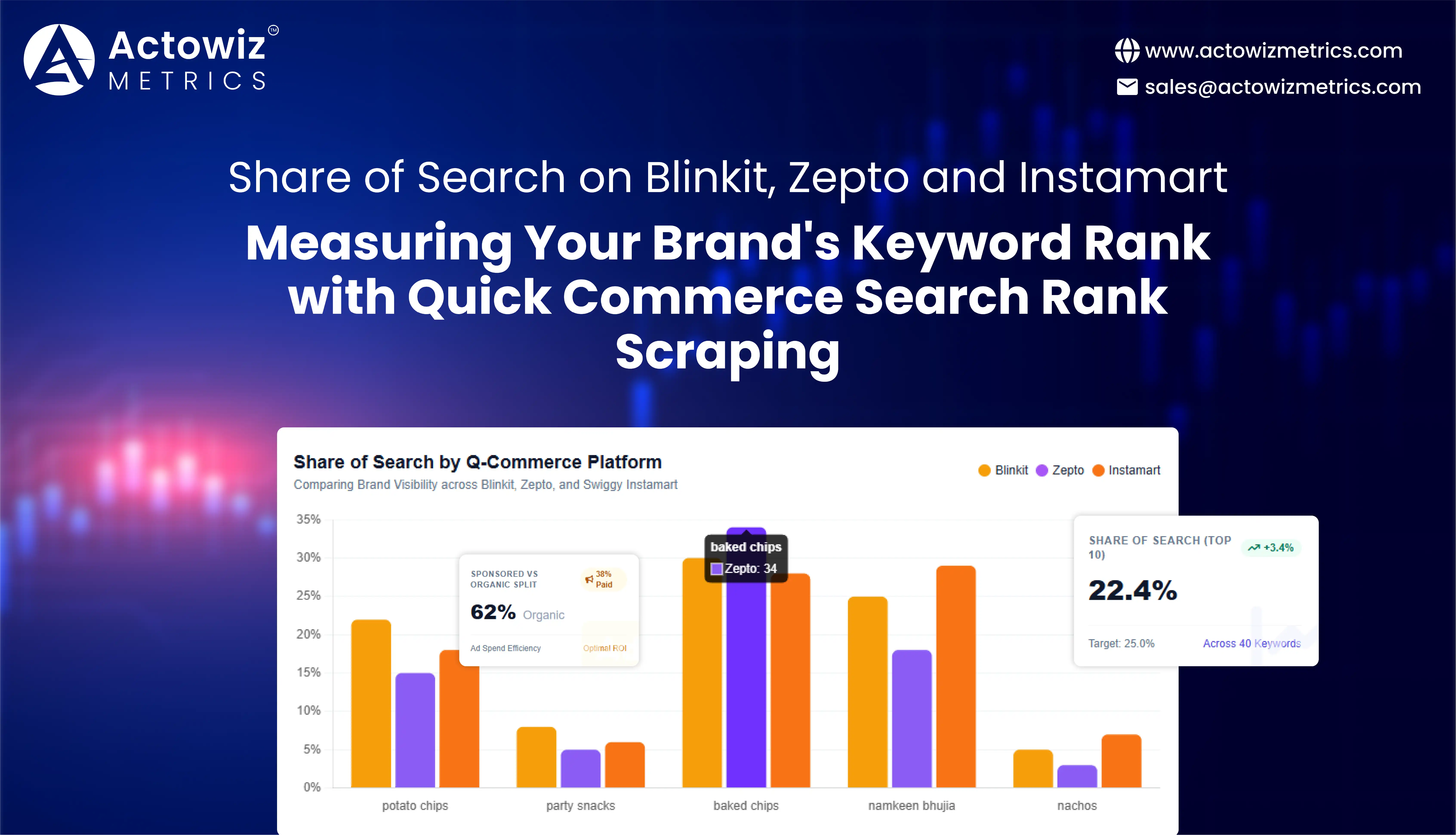
On a quick-commerce app, the shopper types "chips", "cold coffee" or "dishwash liquid" and picks from the first screen. There is no aisle to walk and little scrolling. If your product is not in the first few results, for most shoppers it does not exist. That is why brand teams increasingly ask a sharper question than "Is my product listed?" They ask, "Where do we rank when people search, in which pincodes, and how much of that position are we paying for?"
In October 2026 a performance-marketing agency booked a demo with Actowiz Metrics to discuss "e-commerce and quick-commerce competitor analysis plus keywords with search volume," and a dairy brand asked for "platform-level search and traffic trends" alongside price and availability. This guide explains how Quick Commerce Search Rank Scraping measures share of search on Blinkit, Zepto and Swiggy Instamart, and how brands use it.
Share of search is the share of top search positions your brand holds for a set of relevant keywords. On quick-commerce apps it is shaped by four factors:
| Factor | Why it matters |
|---|---|
| Keyword | "Chips" and "potato chips" can return different results |
| Location | Results depend on the dark store serving the shopper's pincode |
| Availability | Out-of-stock products drop down or disappear |
| Sponsorship | Paid placements appear among organic results |
Because of location, a brand can rank first in one Bengaluru pincode and fifth in another, served by a different dark store.
Start with 30 to 150 keywords per category: generic terms ("chips"), sub-category terms ("baked chips"), need-based terms ("party snacks"), and competitor brand terms. Add Hindi and regional-language spellings where shoppers use them.
Select pincodes that represent your key cities and different dark stores. Many brands start with 20 to 50 pincodes across six to eight metros.
For each keyword, pincode and platform, collect the first screen (and optionally the first two or three screens) of results: position, product name, brand, pack size, price, discount, availability and a sponsored-label flag.
| Metric | Definition |
|---|---|
| Average rank | Mean position of your best-ranked product per keyword |
| Top-3 share | Share of keyword-pincode searches where your brand appears in the top 3 |
| Share of search | Your brand's share of all top-10 positions |
| Organic share | Share of search excluding sponsored positions |
| Sponsored share | Share of top-10 positions that are paid placements for your brand |
| Availability-adjusted rank | Rank counting only in-stock products |
Collect daily or several times a week to see how campaigns, stock-outs and competitor activity change your position.
The record below is illustrative.
{
  "platform": "blinkit",
  "city": "Bengaluru",
  "pincode": "560102",
  "keyword": "potato chips",
  "position": 2,
  "product_name": "Sample Salted Potato Chips 90 g",
  "brand": "Sample Snacks",
  "pack_size": "90 g",
  "price_inr": 40,
  "mrp_inr": 50,
  "in_stock": true,
  "sponsored": true,
  "collected_at": "2026-10-07T11:00:00+05:30"
}
| Keyword (illustrative, 40 pincodes) | Platform | Our avg rank | Top-3 share | Our share of search | Sponsored share of our positions |
|---|---|---|---|---|---|
| potato chips | Blinkit | 2.8 | 64% | 22% | 45% |
| potato chips | Zepto | 4.1 | 38% | 15% | 30% |
| potato chips | Instamart | 3.5 | 51% | 18% | 20% |
| party snacks | Blinkit | 6.2 | 12% | 8% | 70% |
| nachos | Zepto | 9.4 | 0% | 3% | 0% |
The table shows a typical picture. The brand ranks well for its core keyword on Blinkit, but almost half of that visibility is paid. On a need-based keyword ("party snacks") it relies heavily on ads, and on an adjacent keyword ("nachos") it barely appears.
Brands often ask for "keywords with search volume." Quick-commerce platforms do not publish keyword search volumes. Actowiz Metrics approaches this in three ways:
The result is a relative index of keyword importance, clearly labelled as an estimate, not a reported search count.
Keyword choice decides whether share of search reflects real shopper behaviour. A balanced set for a snacks brand might look like this:
| Keyword type | Examples | Why include it |
|---|---|---|
| Generic category | chips, namkeen, nachos | Highest traffic, most competitive |
| Sub-category | baked chips, peri peri chips, bhujia | Where challenger brands can win |
| Need-based | party snacks, healthy snacks, tea time snacks | Captures intent, not product names |
| Brand terms | your brand, competitor brands | Shows defence and conquest positions |
| Local language | "chips" variants in Hinglish, regional spellings | Matches how many shoppers type |
| Seasonal | Diwali snacks, IPL snacks, monsoon snacks | Captures demand spikes |
Review the list every quarter using autocomplete suggestions and your own sales data. Keywords that never show your category's products can be dropped.
Share of search is most powerful when linked to sales. Brands that join rank data with their own platform sales typically see three patterns:
These patterns help teams decide where to invest: in stock, in content, or in ads.
Blinkit, Zepto and Swiggy Instamart by default, with Flipkart Minutes, BigBasket and Amazon's quick-commerce service available on request.
Most brands begin with 50 to 100 keywords and 20 to 50 pincodes, then expand.
Yes. Results labelled as sponsored or ads are flagged, so paid and organic positions can be separated.
No. Actowiz Metrics collects public search results only, without any personal data.
Actowiz Metrics tracks share of search, price, availability and promotions across Blinkit, Zepto and Instamart for FMCG and D2C brands. Book a 15-minute demo to see your brand's keyword ranks in your top pincodes.
Expert blogs, research reports and infographics — practical, data-driven reading across e-commerce and quick-commerce.
Most fields are optional — the more you share, the better your sample.


.webp "infographics")
.webp "infographics")