BLOG
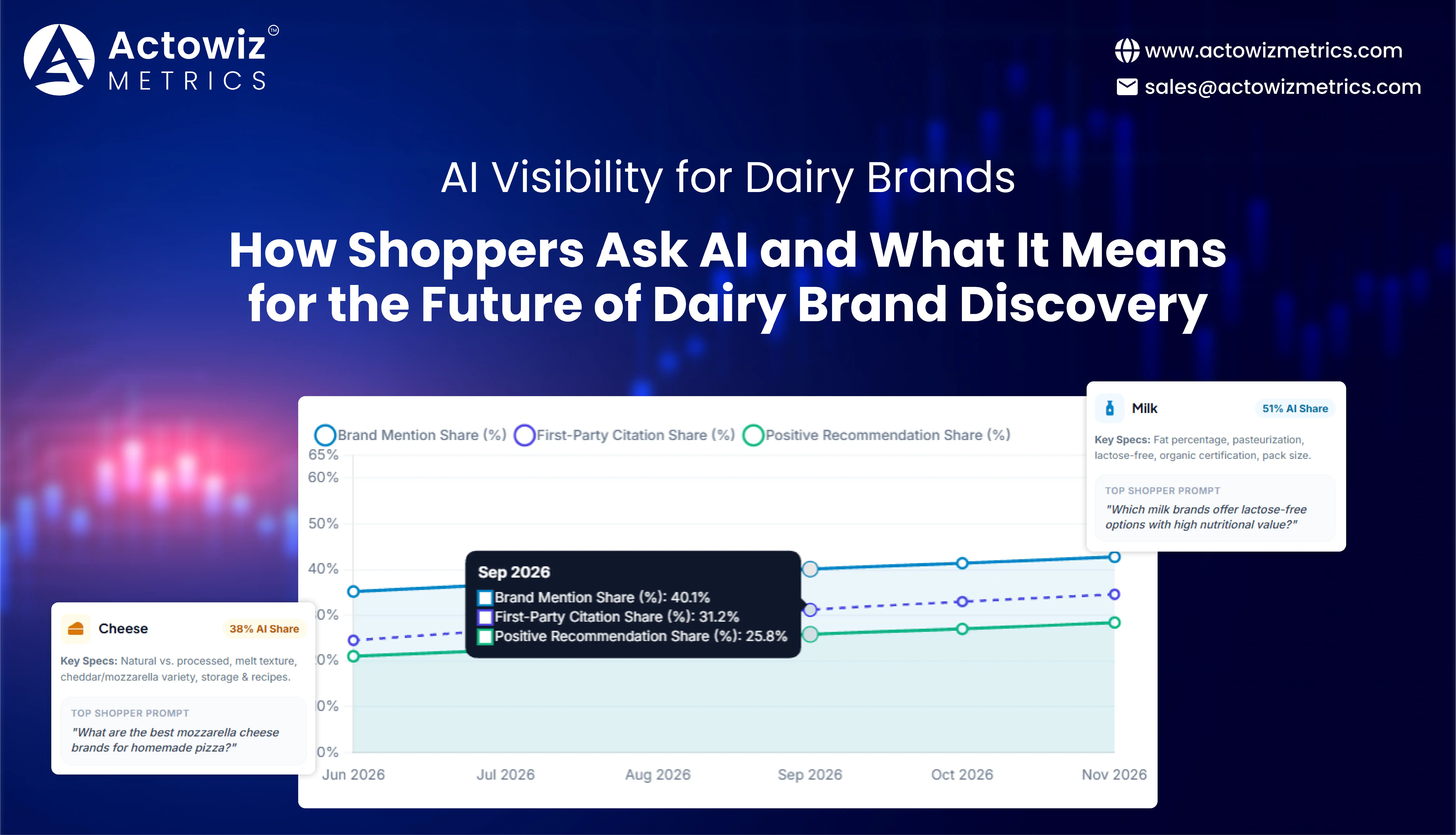


Dairy brand discovery is changing as consumers increasingly use AI-powered search tools to research products, compare brands, understand ingredients, and find recommendations. Instead of relying exclusively on traditional search engines, shoppers can now ask conversational questions such as which milk brand offers better nutritional value, which cheese is suitable for cooking, or which yogurt products contain specific ingredients.
AI Visibility for Dairy Brands helps businesses understand whether their products appear in these AI-generated answers and how frequently competitors receive recommendations. By monitoring the Share of AI Leaderboard, dairy manufacturers, retailers, and marketing teams can identify brand mentions, measure competitive presence, and discover gaps in digital visibility.
For dairy businesses, the challenge is no longer simply attracting website traffic. It is ensuring that accurate, useful, and authoritative product information is available wherever customers research purchasing decisions.
Google introduced AI Overviews in Search in 2024 and expanded AI-powered search experiences through AI Mode in 2025. Google also began rolling out AI Mode in India in July 2025. These developments make AI discovery an increasingly relevant consideration for dairy marketing strategies.
Dairy shoppers have different research requirements depending on the product, price, dietary preference, and purchasing occasion. Someone looking for everyday milk may prioritize freshness, availability, and price, while another shopper comparing cheese brands may investigate ingredients, texture, fat content, and suitability for particular recipes.
Dairy Brand Visibility Across AI Assistants measures how frequently individual dairy companies appear in responses generated by platforms such as ChatGPT, Google AI experiences, Gemini, and Perplexity. Monitoring AI Visibility for Dairy Brands helps businesses identify whether their products are included in relevant recommendations, comparisons, and informational responses.
For example, a dairy company can track questions such as:
The objective is to evaluate brand presence across multiple questions rather than relying on one search query. Each platform may generate different responses because its retrieval systems, available sources, and interpretation of user intent can differ.
A useful measurement framework includes brand mentions, citations, competitor appearances, recommendation frequency, and sentiment. These indicators help marketing teams distinguish between being mentioned, being recommended, and being supported by an authoritative source.
Why does this matter? A dairy company might have strong traditional search visibility but limited representation in AI-generated answers. Measuring both channels helps identify opportunities to improve product information, content quality, and digital discoverability.
AI recommendations depend on the information available to the platform, the shopper's question, and the relevance of different products and sources. Product descriptions, structured information, reviews, and third-party content can all contribute to how products are presented.
AI-Recommended Dairy Brand Rankings help marketing teams understand which companies appear most frequently in answers to relevant consumer questions. These rankings should be measured through repeatable prompts and consistent evaluation criteria rather than assumptions about which brands are popular.
For dairy manufacturers, product information needs to be detailed and consistent. A milk product listing should clearly communicate its product type, fat percentage, packaging size, ingredients, and relevant nutritional information. A yogurt listing should distinguish between plain, flavored, Greek-style, and other product varieties.
OpenAI explains that ChatGPT shopping results can use structured metadata, product descriptions, prices, and third-party information when presenting relevant products. It also notes that AI-generated product descriptions and review summaries are not necessarily verified statements.
Businesses should therefore focus on maintaining accurate information across:
A ranking should also distinguish between a brand appearing in an answer and receiving a positive recommendation. A company may be mentioned in a comparison without being selected as the preferred option.
For decision-makers, the practical benefit is a clearer understanding of the information influencing product discovery and the improvements needed to strengthen brand representation.
Understanding competitive visibility requires more than counting how many times a company appears in AI-generated responses. Dairy businesses need to understand their position relative to competitors, the product categories in which they appear, and the questions where competing brands receive greater attention.
Dairy Brand Share of AI provides a framework for evaluating how frequently a particular brand appears compared with other brands across a defined collection of relevant AI responses. By tracking AI Visibility for Dairy Brands, companies can identify their relative presence across product categories, shopper questions, and AI platforms.
A practical measurement model can include:
The following table illustrates the verified market developments that make this measurement increasingly relevant.
| Year | Verified development or market indicator | Business implication |
|---|---|---|
| 2020–2023 | No consistent, comparable public AI brand-visibility benchmark is established in the sources used here. | Establish a baseline using documented historical records where available. |
| 2024 | Global milk production reached approximately 950 million tonnes, growing 1.1%. | Growing dairy production makes accurate category and product information important. |
| 2025 | Global milk production increased 2.1% to 1,005 million tonnes. | Dairy businesses need to monitor product and competitor visibility across markets. |
| 2025 | Google began rolling out AI Mode in India. | Conversational discovery became an additional consideration for Indian brands. |
| 2026 | OECD-FAO projects global milk production growth of 2% annually over the following decade. | Continued market expansion creates opportunities for better product discovery and competitive intelligence. |
Sources: OECD-FAO Agricultural Outlook 2025–2034 and 2026–2035; Google India.
These figures describe dairy production and AI-search developments, not measured dairy-brand visibility. They should not be interpreted as actual AI ranking or market-share statistics.
A particularly useful approach is to compare brand visibility by prompt category. For example, a company might appear frequently for questions about milk but rarely for questions about cheese or yogurt. This identifies specific areas where product information and educational content need improvement.
Marketing leaders can use these findings to prioritize content investments, identify competitors gaining visibility, and monitor whether optimization activities produce measurable changes.
Traditional competitor analysis often focuses on product pricing, promotional activity, retail distribution, packaging, and search-engine rankings. However, AI-generated answers introduce another competitive environment in which brands may be discussed, compared, or recommended without consumers visiting conventional search-result pages.
Dairy Competitor Visibility in AI Search helps businesses understand how rival companies appear in responses to the same consumer questions.
Consider a shopper researching packaged milk. They might ask an AI assistant to compare several brands based on price, nutritional information, packaging, and availability. The response may mention different companies depending on the question and the information available to the platform.
For dairy manufacturers, competitor monitoring should examine:
An important research finding comes from Yext's October 2025 study, which analyzed 6.8 million AI citations across ChatGPT, Gemini, and Perplexity. It reported that 86% of citations came from brand-managed sources, including websites and listings. First-party websites accounted for 44% of citations, listings for 42%, and reviews and social sources for 8%.
This research provides an important strategic lesson: businesses should not overlook the information they directly control.
For dairy companies, maintaining accurate product pages, consistent retailer listings, and detailed product descriptions can help improve the information available to AI systems.
Competitor monitoring should also account for regional differences. A brand that appears frequently in one market may have limited representation in another because product availability, local retailers, language, and consumer preferences differ.
The most actionable insight comes from identifying the exact questions where competitors consistently appear and understanding what information supports their visibility.
Benchmarking helps companies understand whether their AI visibility is improving, declining, or remaining unchanged. However, comparisons must use consistent prompts, platforms, markets, and measurement periods.
AI Visibility Benchmarking for Dairy Brands allows marketing teams to evaluate their performance against competitors using standardized research methods. Regularly tracking AI Visibility for Dairy Brands also helps identify changes in brand mentions, product recommendations, and source citations.
A reliable benchmarking process should include the following activities.
Develop questions based on real shopper research needs. Include informational, comparison-based, transactional, and product-specific queries.
Examples include:
Use the same questions across supported AI assistants. Record the responses, brand mentions, citations, and recommendations. Platform-specific results should be reported separately because different systems may produce different answers.
Record the companies appearing in each response, their product categories, the sources cited, and the context in which they are mentioned.
Repeat the same research at regular intervals. Compare results monthly or quarterly to identify changes without confusing temporary response variations with sustained improvements.
Identify questions where the company does not appear but relevant competitors do. Review product descriptions, website coverage, supporting evidence, and third-party information to understand possible reasons.
The following table provides a practical benchmark structure. It is a measurement template, not a set of fabricated industry results.
| Benchmark indicator | What it measures | Recommended reporting |
|---|---|---|
| Brand mentions | Frequency of brand appearances | Monthly |
| Competitor mentions | Relative competitor presence | Monthly |
| Citation frequency | Sources supporting AI responses | Monthly |
| Recommendation frequency | Positive product recommendations | Monthly |
| Product coverage | Visibility across dairy categories | Monthly |
| Sentiment | Context surrounding brand mentions | Monthly |
| Platform differences | Variations across AI assistants | Monthly |
Benchmarking should also distinguish between visibility and business performance. An increase in AI mentions does not automatically prove increased sales, website traffic, or customer acquisition. Companies should connect visibility measurements with available referral traffic, conversions, retailer performance, and other business indicators.
This approach gives dairy marketing teams a more reliable foundation for evaluating digital discovery opportunities.
Different dairy categories generate different consumer questions. A single generic content strategy cannot adequately address the information requirements of every product type.
AI Recommendations Across Milk, Cheese, Butter and Yogurt should therefore be monitored separately to understand the information shoppers seek and how competing brands are represented.
Milk-related questions commonly involve fat content, pasteurization, lactose-free options, organic certification, packaging, and nutritional composition. Businesses should maintain accurate product specifications and distinguish clearly between different milk varieties.
Cheese discovery involves product types, ingredients, texture, flavor, storage, and cooking applications. Brands can improve their information coverage through detailed descriptions of cheddar, mozzarella, processed cheese, cream cheese, and other relevant categories.
Butter-related searches can involve salted and unsalted varieties, fat content, ingredients, packaging, and cooking suitability. Accurate product information helps avoid confusion between butter, spreads, and other similar products.
Yogurt shoppers may investigate protein content, added sugar, live cultures, flavors, ingredients, and dietary preferences. Product pages should distinguish between plain yogurt, flavored yogurt, Greek-style yogurt, and other varieties without making unsupported health claims.
OECD-FAO's 2026 Agricultural Outlook highlights important differences in global dairy consumption. It identifies fresh dairy products as a major consumption category and discusses the importance of cheese and butter in particular markets. It also notes that around 25% of global milk is expected to be further processed into products such as butter, cheese, milk powders, and whey over the coming decade.
The following framework connects these market characteristics with practical content opportunities.
| Dairy category | Important product information | Potential shopper questions |
|---|---|---|
| Milk | Fat percentage, ingredients, processing, packaging | Which milk is suitable for my preferences? |
| Cheese | Type, ingredients, texture, storage | Which cheese is best for cooking? |
| Butter | Salt content, ingredients, fat content | What is the difference between salted and unsalted butter? |
| Yogurt | Protein, sugar, ingredients, product type | Which yogurt has the nutritional profile I want? |
For dairy brands, category-specific monitoring can reveal where competitors receive more attention and which product questions remain insufficiently addressed.
Rather than producing repetitive promotional content, businesses should publish useful product information that answers genuine customer questions. Clear specifications, accessible explanations, reliable sourcing, and consistent product data create a stronger foundation for AI-assisted discovery.
Actowiz Metrics helps dairy manufacturers, food brands, and marketing teams understand their competitive position through structured data collection, AI-search monitoring, and market intelligence.
Its approach to measuring Share of AI can help businesses evaluate brand mentions, competitor appearances, product-category representation, and citation patterns across supported AI platforms. By monitoring AI Visibility for Dairy Brands, companies can identify where their products appear in AI-generated answers and where competitors receive stronger representation.
Key areas of support include:
Actowiz Metrics can also help businesses organize collected information into structured reports and dashboards, making it easier for marketing and strategy teams to identify gaps and prioritize improvements.
The objective is to transform scattered AI-search observations into actionable competitive intelligence that supports better digital marketing decisions.
AI-powered discovery is creating another important channel for dairy brands to build awareness and connect with potential customers. Shoppers can use conversational platforms to compare milk products, explore cheese varieties, evaluate butter options, and discover yogurt brands based on their individual requirements.
For dairy manufacturers, understanding this changing environment requires consistent monitoring, accurate product information, and meaningful competitor comparisons. Competitor Analysis for Brands can help businesses identify which competitors appear in AI-generated responses, which product categories attract attention, and where opportunities exist to improve their digital presence.
Tracking AI Visibility for Dairy Brands gives marketing teams a structured way to evaluate brand mentions, citations, recommendations, and competitive performance across AI platforms.
Ready to understand your dairy brand's position in the evolving AI-search landscape? Partner with Actowiz Metrics to explore AI visibility monitoring, competitor intelligence, and data-driven market insights that support smarter brand discovery and competitive decision-making!
Expert blogs, research reports and infographics — practical, data-driven reading across e-commerce and quick-commerce.
Most fields are optional — the more you share, the better your sample.
.webp "infographics")
.webp "infographics")