BLOG
HALLOWEEN SPECIAL OFFER
Data Analytics & Intelligence Solutions
Turn Data into Smarter Business Decisions!
Offer Terms & Conditions Apply






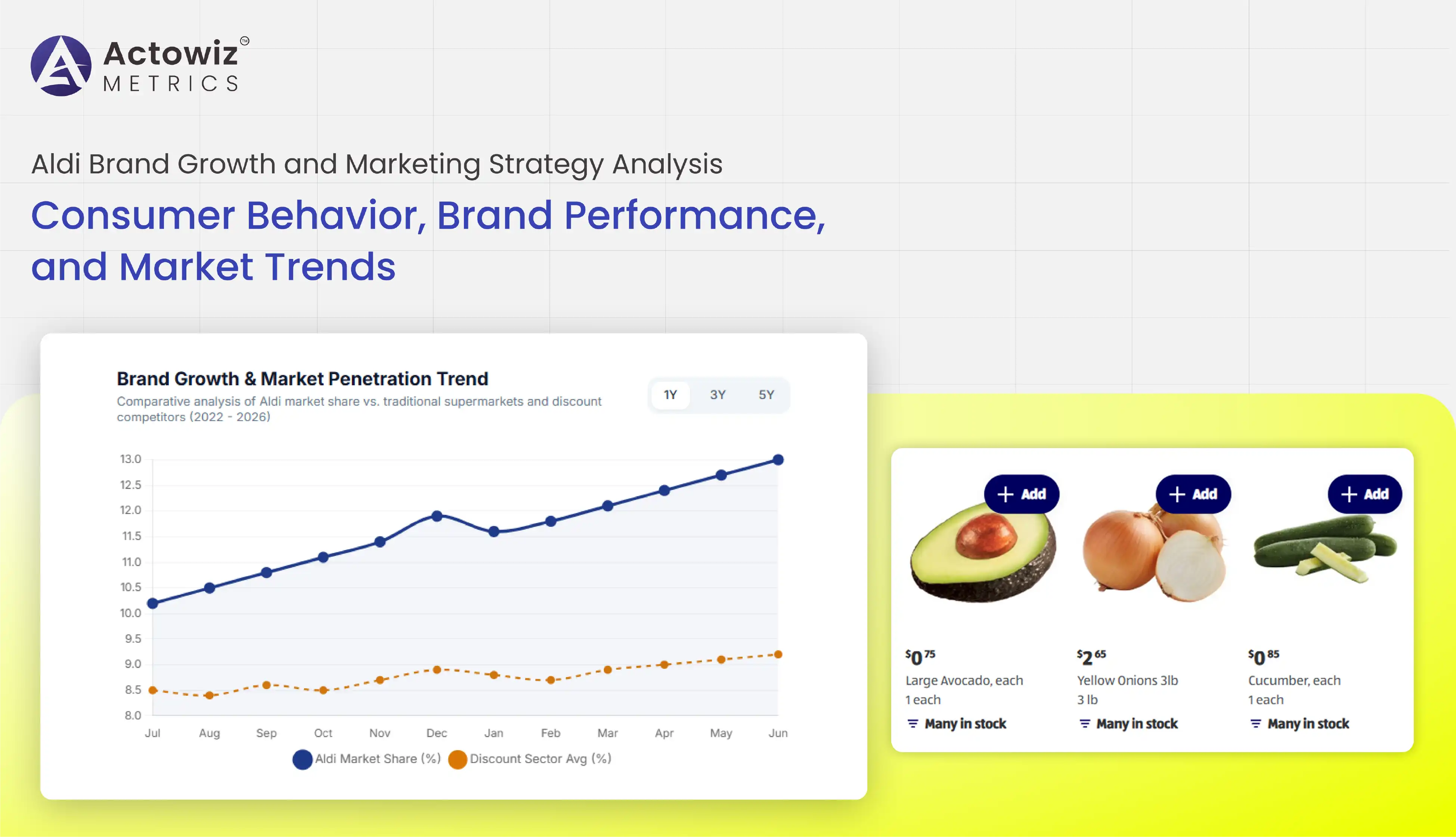
The retail grocery industry has experienced remarkable transformation over the past several years as consumers increasingly prioritize affordability, convenience, and product quality. ALDI has emerged as one of the fastest-growing grocery retailers by consistently delivering value through a streamlined operating model, efficient supply chain, and customer-centric merchandising strategies. Businesses, manufacturers, suppliers, and market researchers rely on Aldi Brand Growth and Marketing Strategy Analysis to understand the retailer's expansion strategies, consumer engagement, assortment optimization, and competitive positioning across global markets.
Modern retail intelligence extends beyond traditional sales tracking. Organizations now depend on Price & promotion intelligence to monitor pricing fluctuations, promotional campaigns, private-label performance, seasonal product launches, and competitor responses. These insights help brands optimize pricing strategies, improve promotional effectiveness, identify market opportunities, and maximize profitability while responding quickly to changing consumer preferences.
This research report explores Aldi's marketing initiatives, consumer behavior trends, pricing strategies, store expansion, and retail performance from 2020 to 2026. It provides data-driven insights that enable retailers, FMCG brands, investors, and analytics teams to benchmark performance, anticipate market shifts, and make informed strategic decisions in an increasingly competitive grocery landscape.
ALDI's continued growth stems from operational efficiency, private-label dominance, and a disciplined pricing strategy that consistently appeals to value-conscious shoppers. Businesses increasingly use Aldi marketing strategy analysis to evaluate how ALDI differentiates itself through simplified store layouts, limited assortments, exclusive brands, and targeted promotional campaigns. Rather than competing on extensive product selection, ALDI focuses on delivering high-quality essentials at competitive prices while maintaining lean operational costs.
Consumer shopping behavior has evolved significantly between 2020 and 2026 due to inflation, changing purchasing habits, and increased digital engagement. ALDI has capitalized on these shifts by expanding store networks, improving online ordering capabilities, and enhancing sustainable sourcing initiatives. Its private-label products continue to gain consumer trust by offering quality comparable to national brands at significantly lower prices.
Retail intelligence platforms enable brands to monitor promotional calendars, pricing changes, category performance, and inventory availability across stores. These insights help suppliers negotiate better retail partnerships while allowing manufacturers to identify emerging consumer preferences and optimize product positioning.
| Year | Store Growth (%) | Private Label Share (%) | Customer Traffic Growth (%) |
|---|---|---|---|
| 2020 | 5.8 | 82 | 6.5 |
| 2021 | 6.2 | 83 | 7.3 |
| 2022 | 7.1 | 84 | 8.6 |
| 2023 | 8.3 | 85 | 9.4 |
| 2024 | 9.1 | 86 | 10.8 |
| 2025* | 9.8 | 87 | 11.6 |
| 2026* | 10.5 | 88 | 12.3 |
As discount grocery competition intensifies, businesses that continuously analyze store expansion, promotional effectiveness, and evolving customer expectations are better positioned to improve market penetration and strengthen long-term retail partnerships.
Retail success increasingly depends on timely, accurate, and actionable market intelligence. Organizations leverage Aldi Retail Market Intelligence to evaluate assortment changes, promotional effectiveness, category expansion, customer demand, and regional market performance. These insights help retailers and consumer brands respond proactively to changing competitive conditions rather than relying solely on historical sales data.
Between 2020 and 2026, grocery retail has become increasingly data-driven. Inflationary pressures, changing consumer purchasing patterns, and heightened price sensitivity have encouraged retailers to refine promotional strategies and optimize inventory planning. ALDI's ability to maintain everyday low pricing while expanding premium private-label offerings demonstrates how data-driven decision-making supports sustainable growth.
Advanced retail analytics allow businesses to compare pricing across competitors, evaluate shelf availability, identify assortment gaps, and monitor promotional frequency across multiple product categories. Manufacturers can use these insights to improve launch strategies, optimize pricing architecture, and strengthen retailer relationships. Investors and market analysts also benefit from tracking expansion trends, customer acquisition, and category performance to assess long-term growth opportunities.
| Year | Digital Grocery Adoption (%) | Promotion Effectiveness Index | Inventory Accuracy (%) |
|---|---|---|---|
| 2020 | 28 | 72 | 89 |
| 2021 | 34 | 75 | 90 |
| 2022 | 41 | 79 | 92 |
| 2023 | 48 | 83 | 93 |
| 2024 | 54 | 86 | 95 |
| 2025* | 59 | 89 | 96 |
| 2026* | 64 | 92 | 97 |
Organizations that combine pricing intelligence, assortment monitoring, promotional tracking, and consumer behavior analytics gain a significant competitive advantage. Leveraging comprehensive retail intelligence enables faster strategic decisions, improved merchandising effectiveness, stronger customer engagement, and greater resilience in an increasingly dynamic grocery marketplace.
As grocery retail becomes increasingly competitive, brands and retailers require deeper visibility into market positioning, promotional effectiveness, and assortment performance. Aldi Retail Benchmarking Insights enable businesses to compare ALDI's operational strategies with leading supermarket chains, helping identify strengths, market gaps, and opportunities for growth. Benchmarking provides a structured approach to evaluating pricing consistency, private-label penetration, store productivity, customer satisfaction, and promotional execution.
Between 2020 and 2026, ALDI strengthened its market presence through strategic store expansion, efficient supply chain management, and continued investment in private-label innovation. While many traditional retailers expanded product assortments, ALDI maintained its focused inventory model, reducing operational costs and improving inventory turnover. This strategy has contributed to higher customer loyalty and stronger value perception among budget-conscious shoppers.
Retail benchmarking also enables suppliers and FMCG brands to understand category performance, identify emerging consumer trends, and optimize product placement strategies. By comparing pricing, assortment breadth, promotional frequency, and customer engagement across competing retailers, businesses can refine merchandising decisions and improve retail execution.
| Year | Market Share Growth (%) | Customer Satisfaction Score | Private Label Penetration (%) |
|---|---|---|---|
| 2020 | 4.8 | 82 | 81 |
| 2021 | 5.5 | 83 | 82 |
| 2022 | 6.3 | 84 | 83 |
| 2023 | 7.2 | 86 | 85 |
| 2024 | 8.1 | 88 | 86 |
| 2025* | 8.9 | 89 | 87 |
| 2026* | 9.6 | 91 | 88 |
Organizations using continuous benchmarking can quickly identify competitive threats, measure category performance, monitor consumer preferences, and develop data-backed strategies that improve profitability while maintaining long-term retail competitiveness.
Pricing remains one of the most influential factors affecting grocery purchasing decisions. Businesses increasingly depend on Aldi Store Pricing Intelligence to monitor everyday prices, promotional discounts, seasonal campaigns, and category-level pricing dynamics. Accurate pricing intelligence helps retailers protect margins while ensuring competitive positioning in highly price-sensitive markets.
From 2020 to 2026, rising inflation and changing consumer purchasing behavior placed greater emphasis on value-driven shopping. ALDI responded by maintaining consistent low-price strategies while selectively expanding premium and organic product offerings. Continuous monitoring of competitor prices allowed the retailer to preserve its value proposition without compromising customer trust.
For manufacturers and suppliers, pricing intelligence supports more effective product launches, promotional planning, and revenue optimization. Retail analytics platforms provide real-time visibility into shelf prices, promotional frequency, stock availability, and regional price variations. These insights help businesses identify pricing gaps, forecast demand, and adjust merchandising strategies based on market conditions.
| Year | Average Price Competitiveness Index | Promotional Coverage (%) | Customer Price Perception (%) |
|---|---|---|---|
| 2020 | 92 | 28 | 84 |
| 2021 | 93 | 30 | 85 |
| 2022 | 94 | 32 | 87 |
| 2023 | 95 | 35 | 89 |
| 2024 | 96 | 37 | 91 |
| 2025* | 97 | 39 | 92 |
| 2026* | 98 | 41 | 94 |
Businesses that integrate continuous pricing intelligence into their decision-making processes improve promotional efficiency, strengthen competitive positioning, reduce pricing risks, and respond faster to evolving consumer expectations across dynamic grocery markets.
The growing complexity of grocery retail requires organizations to automate data collection for faster and more accurate market intelligence. Aldi pricing and product data scraping enables retailers, suppliers, brands, and analysts to collect structured information on product prices, promotions, availability, private-label assortment, ratings, and category performance. Automated data collection significantly reduces manual effort while providing near real-time visibility into retail operations.
Between 2020 and 2026, businesses increasingly adopted automated retail intelligence solutions to monitor thousands of SKUs across multiple locations and digital channels. As pricing changed more frequently and promotional campaigns became increasingly dynamic, automated data extraction allowed organizations to detect market shifts immediately and optimize strategic decisions.
Data collected through automated retail intelligence supports demand forecasting, assortment optimization, competitor analysis, pricing strategy development, promotional planning, and category management. Marketing teams can identify successful campaigns, procurement teams can negotiate more effectively with suppliers, and executives can make informed investment decisions using comprehensive retail performance data.
| Year | Businesses Using Automation (%) | Average Data Accuracy (%) | Decision Speed Improvement (%) |
|---|---|---|---|
| 2020 | 35 | 88 | 26 |
| 2021 | 42 | 90 | 31 |
| 2022 | 50 | 92 | 37 |
| 2023 | 58 | 94 | 43 |
| 2024 | 66 | 96 | 49 |
| 2025* | 73 | 97 | 55 |
| 2026* | 80 | 98 | 61 |
Organizations investing in automated retail data collection gain a competitive advantage by accessing timely, high-quality intelligence that supports pricing optimization, merchandising improvements, customer engagement, inventory planning, and long-term business growth across rapidly evolving grocery markets.
Reliable retail intelligence is essential for brands seeking to understand changing customer preferences, pricing dynamics, and competitive activity. Aldi retail data extraction provides structured datasets covering product catalogs, pricing, promotions, stock availability, category trends, and store-level performance. These insights empower retailers, FMCG brands, market researchers, and investors to make informed decisions based on accurate and timely market information.
From 2020 to 2026, the volume of retail data generated across online and physical stores has grown significantly. Organizations increasingly rely on automated extraction processes to consolidate data from multiple sources into centralized analytics platforms. This enables continuous monitoring of assortment changes, promotional campaigns, seasonal demand, and regional pricing variations.
Retail data extraction also supports advanced analytics such as demand forecasting, assortment optimization, competitor benchmarking, and customer behavior analysis. By integrating extracted retail data into business intelligence systems, organizations can identify emerging opportunities, reduce operational risks, and improve strategic planning across merchandising, marketing, and supply chain functions.
| Year | Products Monitored (Index) | Retail Data Accuracy (%) | Analytics Adoption (%) |
|---|---|---|---|
| 2020 | 100 | 89 | 42 |
| 2021 | 118 | 91 | 48 |
| 2022 | 138 | 93 | 55 |
| 2023 | 162 | 95 | 63 |
| 2024 | 189 | 96 | 71 |
| 2025* | 218 | 97 | 78 |
| 2026* | 250 | 98 | 85 |
As retail competition intensifies, organizations that leverage comprehensive retail data gain greater visibility into market trends, improve forecasting accuracy, optimize pricing strategies, and enhance customer engagement. High-quality retail intelligence serves as the foundation for sustainable growth and long-term competitive advantage.
Actowiz Metrics is a trusted provider of retail market intelligence, web scraping, and advanced analytics solutions that help businesses make faster and smarter decisions. Our expertise in Aldi Brand Growth and Marketing Strategy Analysis enables retailers, FMCG brands, manufacturers, investors, and research firms to access reliable insights into pricing trends, promotions, consumer behavior, product assortment, and competitive performance.
Using AI-powered data extraction and automated monitoring technologies, Actowiz Metrics delivers accurate, scalable, and near real-time retail intelligence across online and offline channels. Our customized solutions support price monitoring, promotional tracking, assortment analysis, competitor benchmarking, demand forecasting, and market expansion planning. Clients benefit from structured datasets, interactive dashboards, and actionable insights that improve operational efficiency and strategic decision-making.
Whether your objective is to optimize pricing, monitor competitors, identify market opportunities, or strengthen category performance, Actowiz Metrics provides comprehensive retail intelligence tailored to your business requirements. Our commitment to data quality, innovation, and customer success ensures organizations stay ahead in today's rapidly evolving retail environment.
The grocery retail industry continues to evolve as consumers demand greater value, convenience, and personalized shopping experiences. Aldi Brand Growth and Marketing Strategy Analysis provides organizations with critical insights into brand expansion, pricing strategies, promotional effectiveness, customer engagement, and competitive positioning. Combined with ALDI Grocery Detailed Product Data Analytics, businesses gain a comprehensive understanding of assortment performance, product availability, pricing movements, and market trends that drive informed strategic decisions.
By leveraging advanced retail intelligence, automated data collection, and actionable analytics, retailers and consumer brands can improve merchandising strategies, optimize pricing, strengthen customer loyalty, and identify new growth opportunities in an increasingly competitive marketplace.
Partner with Actowiz Metrics to access industry-leading retail intelligence, data scraping, and analytics solutions that empower your business with accurate, real-time insights for sustainable growth and competitive success!
Expert blogs, research reports and infographics — practical, data-driven reading across e-commerce and quick-commerce.
Most fields are optional — the more you share, the better your sample.
.webp "infographics")
.webp "infographics")