BLOG
HALLOWEEN SPECIAL OFFER
Data Analytics & Intelligence Solutions
Turn Data into Smarter Business Decisions!
Offer Terms & Conditions Apply


Festive Season Product Availability Monitoring India helps brands and online sellers track stock status, identify out-of-stock listings, and protect product discoverability during high-demand shopping periods. By combining marketplace monitoring, inventory intelligence, and search visibility analysis, businesses can identify availability gaps across Amazon, Flipkart, and quick-commerce platforms before they undermine sales opportunities.
India's festive shopping market creates a short but significant window for brands to convert consumer interest into orders. According to Redseer, India's festive e-commerce market generated approximately $14 billion in gross merchandise value (GMV) in 2024, representing 12% year-on-year growth. Redseer also reported that the first 11 days of the 2024 festive sale accounted for approximately $6.2 billion in GMV. These figures highlight why businesses need timely, product-level visibility into stock and listing performance. Source: Redseer, India's Festive E-commerce Market 2024.
For consumer brands, inventory availability and search visibility should be monitored together through Quick Commerce Intelligence. A product may have competitive pricing and an attractive listing, but shoppers cannot purchase it when the selected variant is unavailable. Likewise, a listing that becomes difficult to discover during a promotion may lose valuable traffic even when inventory is available.
Actowiz Metrics helps businesses approach these challenges through structured e-commerce data monitoring, competitive analysis, and actionable reporting. The goal is to help brands identify operational risks, understand marketplace changes, and make better-informed decisions throughout the festive season.
Peak demand product availability and sales rank analytics helps brands compare product availability with changes in demand, promotional activity, and marketplace visibility. This analysis is particularly useful for electronics, fashion, beauty, home appliances, and other categories that experience seasonal shopping surges.
Redseer's historical festive-market analysis demonstrates how quickly online retail demand has expanded. Its 2020 report recorded approximately ₹58,000 crore in gross festive e-commerce sales, while its 2022 reporting placed festive-month online sales at approximately ₹76,000 crore. These are reported market-wide figures, not estimates of individual brand performance. Sources: IBEF's coverage of Redseer's 2020 report and Business Standard's coverage of 2022 sales.
The practical lesson is that brands should not rely exclusively on monthly sales reports or warehouse stock summaries. Monitoring needs to operate at the product and variant level, with frequent checks during high-traffic promotional periods.
Useful indicators include:
Brands can use these indicators to create a prioritized monitoring list. High-priority products may include top-selling SKUs, products receiving promotional investment, and variants with a history of rapid depletion.
The main operational advantage is earlier detection. If a promoted product becomes unavailable, the relevant team can investigate replenishment, seller inventory, fulfilment restrictions, or listing errors rather than discovering the problem after the campaign has ended.
India e-commerce out-of-stock tracking during festive sales helps businesses identify when advertised products are no longer available for purchase across major marketplaces. It also helps distinguish genuine inventory shortages from listing-level issues, variant restrictions, and location-specific delivery limitations.
India's festive sales data shows why this monitoring matters. According to Redseer's 2023 analysis, festive-month online retail GMV was projected to reach approximately ₹90,000 crore, up 18–20% from the previous year. The 2024 festive market subsequently recorded approximately $14 billion in GMV, with growth of 12% year on year. The figures use different reporting periods and currency presentations, so they should not be compared as if they were identical measurements. Sources: Redseer 2023 festive sales outlook and Redseer 2024 market report.
For sellers, an out-of-stock event can have several consequences. A customer may abandon the purchase, choose a competing product, or return later to find that the product is still unavailable. Meanwhile, advertising or promotional placements may continue to attract attention to a product that cannot fulfil demand.
A systematic monitoring process should record:
This information creates an auditable record of availability interruptions. Teams can compare these events with campaign schedules, replenishment records, and sales reports to identify recurring problems.
For example, if a product repeatedly becomes unavailable shortly after a major discount goes live, the business can investigate whether demand forecasting, replenishment timing, seller inventory allocation, or fulfilment capacity needs adjustment. The observation identifies a problem to investigate; it does not, by itself, establish the cause.
The best approach is to connect monitoring alerts to clear responsibilities. Inventory teams can investigate stock, marketplace teams can check listing status, and campaign managers can review promotional exposure. This reduces the chance that an availability issue remains unnoticed because different teams work from separate reports.
Quick commerce festive inventory and product availability tracking gives brands visibility into product availability on rapid-delivery platforms, where local fulfilment conditions can influence whether a customer can place an order.
Quick commerce differs from conventional marketplace retail because availability can vary by service area, fulfilment location, and time. A product may be available in one neighbourhood but unavailable in another. A national inventory summary cannot necessarily reveal these local differences.
The scale of the opportunity is also changing. Redseer's 2025 festive-season outlook projected quick-commerce growth of 150% year on year during the festive period. This was a forecast published in August 2025, not a verified final growth figure. Source: Redseer, Festive Season 2025.
For brands selling packaged foods, beverages, personal care products, beauty essentials, household supplies, and festive gifting items, local availability can be as important as overall distribution.
A useful monitoring framework should examine:
These checks help commercial teams distinguish a broad stock shortage from a local fulfilment gap. For instance, if a product is unavailable in several monitored service areas but remains available elsewhere, the pattern may justify an investigation into local replenishment or distribution.
Actowiz Metrics can support this analysis by organizing marketplace observations into structured datasets and reports. Businesses can use the resulting information to prioritize locations, review product coverage, and coordinate with relevant sales and supply-chain teams.
The important consideration is frequency. A single daily snapshot may miss short-lived availability changes during busy periods. Monitoring frequency should therefore reflect the product's sales velocity, the volatility of its availability, and the operational importance of the channel.
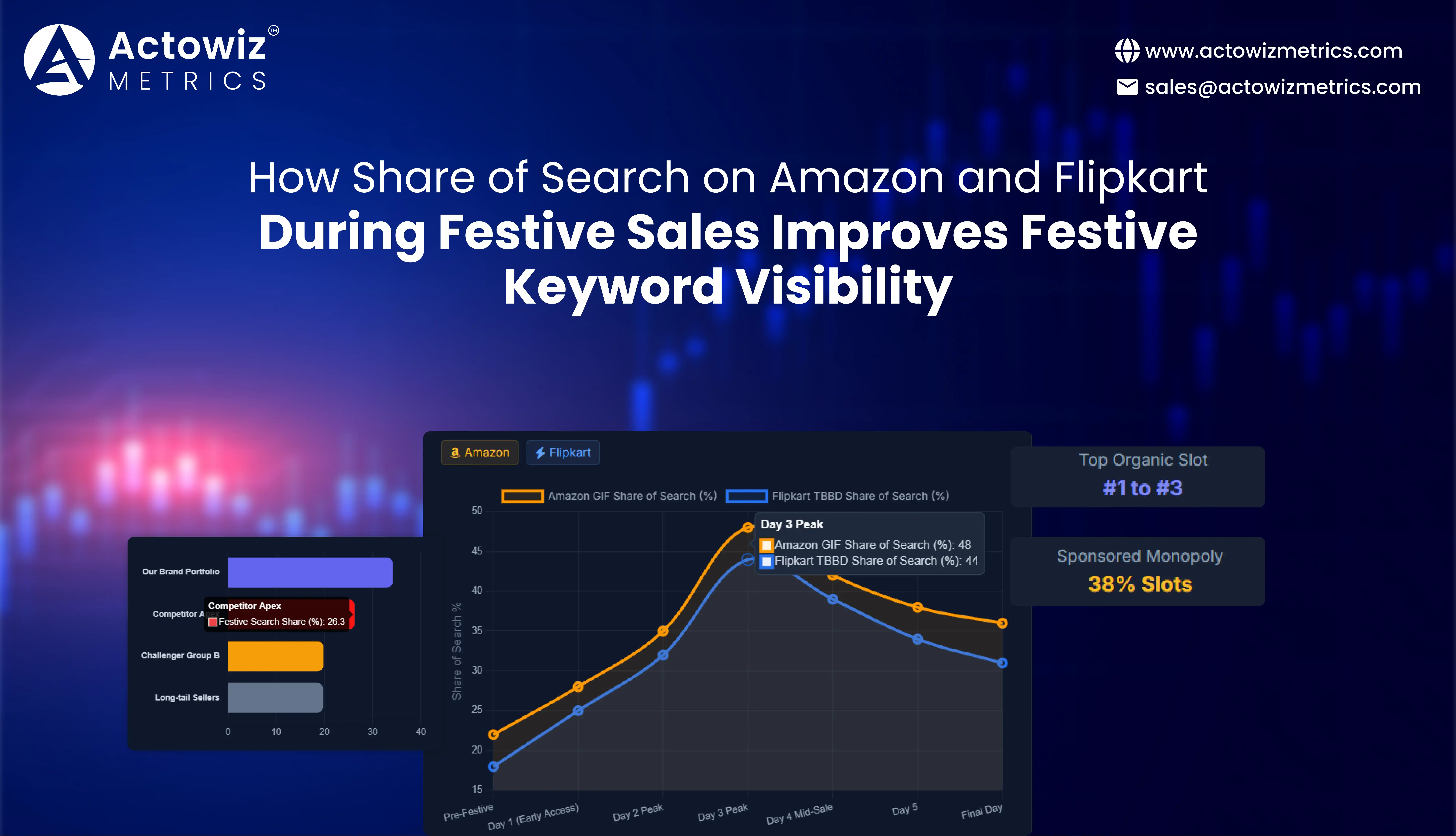
Amazon Flipkart product availability and search rank monitoring combines stock observations with product discoverability indicators to help brands understand how their listings perform across two major Indian e-commerce marketplaces.
A comparison should not assume that both platforms expose identical ranking data or apply identical ranking systems. Businesses need to use the metrics available through their authorized data sources and interpret them in the context of each marketplace.
The monitoring process should focus on three connected questions:
These questions matter because stock status and discoverability measure different things. A product can remain visible but unavailable, while an in-stock product may receive limited visibility for a particular search query.
Brands should track listing URLs or product identifiers, seller details, variant attributes, observed prices, availability status, and relevant search-position indicators. Where supported, these observations can be segmented by keyword, category, seller, and location.
| Monitoring area | Amazon | Flipkart | Business value |
|---|---|---|---|
| Product availability | Track observed listing and variant status | Track observed listing and variant status | Identify products that cannot be purchased |
| Pricing and offers | Record displayed prices and promotions | Record displayed prices and promotions | Compare competitive positioning |
| Search visibility | Monitor available search-position indicators | Monitor available search-position indicators | Detect changes in discoverability |
| Seller and variant coverage | Compare sellers and product configurations | Compare sellers and product configurations | Identify assortment gaps |
| Historical changes | Compare repeated observations | Compare repeated observations | Establish trends and investigate interruptions |
Table: A proposed monitoring framework. It describes metrics businesses can track where data is accessible; it does not imply that either marketplace provides every metric through every interface.
A further consideration is data consistency. Search positions can vary with the query, location, time, sponsored placements, and the marketplace's own systems. Brands should therefore compare like with like and avoid treating a single observed position as a complete measure of search performance.
For decision-makers, the value lies in identifying patterns. If a product remains available but its observed search position changes, the team can investigate pricing, competition, listing quality, and other relevant factors. If the product becomes unavailable at the same time, inventory and fulfilment checks should take priority.
This combined view supports more disciplined decisions than monitoring stock, pricing, and search visibility in separate spreadsheets.
Marketplace Stockout Impact on Product Visibility is an important area of analysis because stock interruptions can coincide with lost purchase opportunities and changes in customer behaviour. However, an out-of-stock event does not automatically prove that a product's organic search rank will decline.
Marketplace search systems consider multiple signals, and their precise weighting can change. Brands should therefore measure observed availability and visibility separately before drawing conclusions about cause and effect.
A practical monitoring approach records the timing of a stockout alongside changes in search visibility, displayed pricing, promotional status, and competitor availability. It then compares the affected period with the product's previous performance and, where appropriate, with similar products that remained available.
This approach is especially useful when evaluating the commercial impact of stock interruptions. A product that becomes unavailable during a high-investment advertising campaign may require a different response from one that experiences a brief interruption outside a major promotion.
The following table outlines how teams can interpret common monitoring signals.
| Observed signal | Possible interpretation | Recommended action |
|---|---|---|
| Product becomes unavailable | Inventory, listing, or fulfilment issue | Verify stock and listing status |
| Product is in stock but less visible | Competition, search conditions, or listing changes | Review comparable queries, pricing, and content |
| A promoted SKU becomes unavailable | Campaign exposure may no longer match purchase availability | Coordinate with advertising and inventory teams |
| Availability differs by location | Local distribution or fulfilment variation | Investigate affected service areas |
| Competitors remain available during a stockout | Shoppers may have alternative purchase options | Review replenishment priorities and assortment strategy |
These are diagnostic interpretations, not guaranteed outcomes. Each signal requires validation against the brand's own operational records and the data available from the marketplace.
For Festive Season Product Availability Monitoring India, the most useful reporting approach connects each stockout to its duration, affected product variants, relevant promotional dates, and subsequent recovery. Teams can then evaluate whether interruptions are recurring and whether operational changes reduce their frequency or duration.
A structured historical record also helps businesses distinguish between an isolated listing problem and a broader replenishment weakness. Over multiple sales periods, these records can support better inventory allocation and campaign planning.
Amazon analytics can help brands assess listing availability, pricing, product performance, and discoverability when the relevant metrics are available through authorized tools or data sources. During festive promotions, these observations should be reviewed alongside inventory and campaign information rather than in isolation.
A daily review should focus on the metrics that can trigger an operational decision. Too many disconnected indicators can make it harder to identify urgent issues.
| Metric | What to record | Why it matters |
|---|---|---|
| In-stock rate | Share of monitored product observations showing availability | Indicates the consistency of observed availability |
| Stockout duration | Time between the first observed unavailable state and recovery | Helps quantify interruption length |
| Variant coverage | Availability by size, colour, capacity, or other configuration | Reveals gaps hidden by parent-product summaries |
| Observed price | Listed price and visible offer, with timestamp | Helps assess promotional and competitive changes |
| Search visibility | Available position or visibility indicator for a fixed query | Tracks discoverability over time |
| Competitor availability | Comparable products and their observed stock status | Highlights alternative products available to shoppers |
| Location coverage | Availability across monitored service areas | Reveals geographic differences |
Metrics require clear definitions. For example, an in-stock rate calculated from observations is not the same as the percentage of time a product was genuinely available throughout the day. The result depends on sampling frequency, monitored locations, product selection, and the treatment of missing observations.
Teams should also avoid interpreting correlation as causation. A drop in observed search visibility during a stockout may justify further investigation, but it does not independently prove that the stockout caused the change.
For a reliable reporting process, brands should establish a baseline before the sale, increase monitoring frequency for priority products during peak periods, and continue tracking after the campaign. Post-sale analysis can reveal recurring shortages, slow recovery, or products that require more accurate demand planning.
The objective is not simply to collect more data. It is to produce a consistent record that helps inventory, marketplace, advertising, and category teams decide what needs attention and when.
Actowiz Metrics provides digital shelf and marketplace intelligence to help brands monitor product availability, pricing, search visibility, seller activity, and reviews across supported platforms. Its published platform information covers Amazon, Flipkart, Blinkit, Zepto, and other marketplaces. Source: Actowiz Metrics.
For businesses preparing for festive campaigns, the objective is to turn marketplace observations into actionable information that supports inventory planning, competitive monitoring, and listing performance reviews.
1. Monitor product availability across channels
Actowiz Metrics can help businesses track observed product availability across supported marketplaces and quick-commerce channels. Brands can use these observations to identify unavailable SKUs, compare product coverage, and investigate recurring gaps.
For Festive Season Product Availability Monitoring India, teams can prioritize products based on sales importance, campaign schedules, and the operational risk associated with interruptions.
2. Track pricing and competitor activity
Promotional periods often involve frequent price changes. Monitoring listed prices, discounts, and competitor offers helps commercial teams understand how their products are positioned during major sales.
Combining pricing observations with availability data also helps teams distinguish between a product that is competitively priced but unavailable and one that remains available at a less competitive price.
3. Evaluate product discoverability
Actowiz Metrics' published Flipkart intelligence offering includes pricing, availability, search rank, sellers, and reviews. These data points can help brands examine changes in marketplace visibility alongside inventory status. Source: Actowiz Metrics Flipkart intelligence.
With Flipkart analytics, businesses can organize product-level observations to identify listing changes, assess competitive positioning, and investigate differences in search visibility across monitored products.
Brands should interpret observed search positions in context because rankings may vary by query, location, and time. Monitoring provides evidence for investigation rather than a guarantee of ranking improvements.
4. Compare performance across rapid-delivery platforms
Quick-commerce monitoring can help businesses understand whether their products are available across selected service areas and how their assortment compares with competing brands.
Actowiz Metrics lists quick-commerce platforms such as Blinkit and Zepto among its supported coverage. Businesses should confirm the precise platforms, locations, products, and monitoring frequency available for their requirements before deployment. Source: Actowiz Metrics platform overview.
5. Turn observations into operational priorities
Data is most valuable when teams know what action to take. Brands can use monitoring reports to prioritize unavailable products, investigate unusual price changes, review competitor stock status, and identify repeated availability interruptions.
A practical workflow connects marketplace observations with internal inventory records, promotional calendars, and fulfilment information. This enables teams to investigate the underlying cause rather than assuming that every availability issue originates in the warehouse.
For example, Amazon's official seller help documentation explains that its Manage Inventory tools let sellers view and update product and inventory listing information. Brands can use marketplace monitoring to identify customer-facing issues and then verify the relevant listing and inventory details in their authorized seller systems. Source: Amazon Seller Central Help.
The same principle applies to other marketplaces: external monitoring identifies a potential issue, while the relevant seller or operational system helps establish the cause.
6. Measure performance across the full sales cycle
A useful monitoring programme begins before the sale, continues throughout the peak period, and remains active after promotions end.
Before the sale, teams can establish availability and visibility baselines. During the sale, they can identify exceptions and prioritize urgent issues. After the sale, they can review stockout duration, location coverage, competitive changes, and recovery patterns.
This approach helps brands improve future campaign planning using observed evidence instead of relying solely on post-campaign sales totals.
India's festive e-commerce market has grown substantially, but published figures must be interpreted according to their reporting periods and whether they represent forecasts or completed sales. The following table brings together selected historical benchmarks to show the scale and evolution of the opportunity.
| Year | Reported festive e-commerce benchmark | Source and context |
|---|---|---|
| 2020 | Approximately ₹58,000 crore in gross sales | IBEF / Redseer |
| 2021 | Approximately ₹65,000 crore in online festive sales | Economic Times / Redseer |
| 2022 | Approximately ₹76,000 crore in festive-month online sales | Business Standard / Redseer |
| 2023 | Approximately ₹90,000 crore projected for the festive month | Redseer forecast |
| 2024 | Approximately $14 billion in festive e-commerce GMV | Redseer market report |
| 2025 | More than ₹60,000 crore in GMV during the first 11 days, according to Redseer's estimate | Redseer analysis |
| 2026 | CashKaro reported over ₹1,000 crore in GMV facilitated across 38 lakh orders during October 7–12 | Economic Times coverage |
Important: These figures are not a directly comparable annual series. They differ in reporting periods, scope, measurement, and whether the numbers are forecasts or reported outcomes. The 2026 figure represents activity facilitated by CashKaro, not total Indian festive e-commerce sales.
For brands, these benchmarks reinforce the need to plan around actual demand patterns and monitor the products that matter most to their business. Market growth alone cannot reveal which SKU is unavailable, which location has a fulfilment gap, or whether a competitor has gained visibility.
A practical pre-sale checklist includes:
Festive sales create valuable opportunities for Indian brands, but strong demand does not automatically translate into completed purchases. Product availability, listing quality, competitive pricing, and discoverability all deserve attention throughout the campaign.
Festive Season Product Availability Monitoring India enables businesses to build a clearer picture of marketplace conditions by tracking stock status, monitoring competitive changes, and identifying product-level issues across Amazon, Flipkart, and quick-commerce platforms. When combined with internal inventory and campaign data, these insights can help teams investigate problems faster and make more informed decisions.
Actowiz Metrics supports this approach with marketplace intelligence designed to help brands monitor the digital shelf and evaluate product performance across supported channels.
Ready to strengthen your festive-season marketplace strategy? Explore Actowiz Metrics to discuss your product availability monitoring, competitor tracking, and digital shelf intelligence requirements before the next major sales event!
Expert blogs, research reports and infographics — practical, data-driven reading across e-commerce and quick-commerce.
Most fields are optional — the more you share, the better your sample.
.webp "infographics")
.webp "infographics")