BLOG
HALLOWEEN SPECIAL OFFER
Data Analytics & Intelligence Solutions
Turn Data into Smarter Business Decisions!
Offer Terms & Conditions Apply


The strongest festive pricing strategy for Indian retailers is to track competitor discounts, product availability, and price changes across Amazon India, Flipkart, Myntra, and other relevant marketplaces—then use verified market data to adjust promotions without sacrificing margins. For Actowiz Metrics, the focus is on turning marketplace observations into timely, evidence-based pricing decisions, not simply matching every competitor's lowest price.
Indian festive sales create a short, high-pressure window in which prices, promotions, stock levels, and product visibility can change rapidly. Indian Marketplace Festive Price Drop Monitoring helps brands track these movements across Amazon India, Flipkart, Myntra, and other relevant platforms so pricing teams can respond to genuine competitive threats without cutting prices unnecessarily. The objective is not to offer the deepest discount on every product. It is to identify where a price adjustment, bundle, bank offer, or promotion can improve conversion while protecting profitability.
For retailers, marketplace sellers, category managers, and e-commerce leaders, effective monitoring connects competitor activity with product demand, inventory, and margin targets. Top Brand Promotion Strategies for Smart Pricing & Promotion should combine verified price observations, comparable product data, promotional conditions, and a clear understanding of how each marketplace serves different shoppers.
India's festive market makes this work especially important. Redseer reported that festive e-commerce generated approximately $14 billion in gross merchandise value (GMV) in 2024, up 12% year over year. Its analysis also found that spending in Tier 2 and smaller cities grew by 13%. These figures indicate a large market with varied regional demand—not a single uniform price-sensitive audience. Redseer's 2024 festive-market analysis
Near-Real-Time Competitor Price Tracking on Indian Marketplaces helps brands identify price movements while a festive campaign is active. Monitoring should capture the listed price, displayed selling price, discount percentage, coupon conditions, bank offers, seller identity, delivery charges where visible, and product availability. These details matter because a product advertised at a lower price may require a card offer or coupon that not every shopper can use.
Amazon India and Flipkart are particularly important for electronics, appliances, home products, beauty, and everyday essentials. Myntra is a key reference point for fashion, footwear, and lifestyle products. Meesho can provide useful comparisons for value-led merchandise, while specialist marketplaces may be more relevant for selected categories. Brands should choose competitors based on product overlap and customer segment, rather than monitoring every seller indiscriminately.
A practical process starts with a defined SKU list and a matched-product rule. Match model numbers, pack sizes, colours, quantities, and specifications before comparing prices. Then classify movements as routine changes, scheduled promotions, competitor undercutting, or apparent pricing anomalies. This reduces false alerts caused by comparing different product variants.
| Year | Reported marketplace or market figure | Pricing implication |
|---|---|---|
| 2020 | Amazon reported orders from 99.3% of India's pin codes during its Great Indian Festival. | National reach makes regional availability and delivery conditions relevant to comparisons. |
| 2021 | Amazon reported that the Great Indian Festival featured more than 75,000 local shops from 450 cities. | Competition includes local and small sellers, not just large national brands. |
| 2022 | Amazon said 80% of its new festive customers came from Tier 2 and Tier 3 towns. | Regional demand and price positioning should be assessed together. |
| 2023 | Flipkart reported 1.4 billion customer visits during its Big Billion Days event. | High traffic makes frequent checks of priority products valuable. |
| 2024 | Amazon reported 140 crore customer visits during its Great Indian Festival. | Brands need to prioritize high-traffic products and commercially important SKUs. |
| 2025 | Amazon reported 276 crore customer visits during its Great Indian Festival. | A larger shopping event increases the importance of monitoring price and offer changes. |
| 2026 | Financial Express reported that Amazon product orders rose by more than 100% year over year in the first 12 hours of the festive sale. | Early campaign activity can shift quickly; verify live SKU-level prices instead of relying on broad market signals. |
These are reported figures from different platforms, events, and measurement periods. They are not a like-for-like series of price changes or sales volumes.
The operational takeaway is straightforward: set monitoring frequency according to product importance. High-traffic hero SKUs may need much more frequent checks than long-tail products. Use alert thresholds based on margin and competitive relevance, not every minor price movement.
Festive Season Competitor Price Drop Monitoring helps distinguish a genuine price cut from a promotion that only appears cheaper. During large campaigns, the final payable amount may reflect a platform discount, seller coupon, bank cashback, exchange benefit, loyalty offer, or bundled product. Comparing only the crossed-out list price can therefore misrepresent the offer available to a shopper.
Brands should record the promotion's conditions alongside the observed price. For example, a discount available only to a specific cardholder should not automatically be treated as the standard market price. Similarly, exchange offers on smartphones and appliances need to be separated from unconditional reductions because the customer's final saving depends on eligibility and the item exchanged.
Indian Marketplace Festive Price Drop Monitoring should also capture timing. Early-access promotions, opening-day offers, weekend deals, and final-day clearance campaigns may have different commercial objectives. A retailer might accept a limited discount at launch to attract attention, then protect margin on replenishment orders. Another may use a deeper reduction near the end of the event to clear slow-moving inventory.
The scale of festive activity supports this level of scrutiny. Amazon reported 11 crore customer visits during the first 48 hours of its 2024 Great Indian Festival, while shoppers saved ₹240 crore through SBI card offers during that period, according to the company. Amazon's opening-period report The example shows why pricing teams must evaluate promotional mechanics, not just headline discounts.
A useful workflow is to classify each offer as unconditional markdown, coupon-based discount, payment-linked benefit, exchange offer, bundle, or loyalty benefit. Then compare the effective price only between offers with sufficiently similar conditions.
Festive Sale Competitor Discount and Promotion Tracking should go beyond recording the largest discount percentage. A high discount against an inflated or outdated reference price may not provide a meaningful comparison. A smaller reduction on a popular product may be more commercially significant if it improves the competitor's effective price position or pushes the product into a prominent price band.
Retailers should evaluate at least five signals: effective selling price, discount depth, offer duration, promotion type, and product visibility. For sponsored listings, record the placement and search term where observed, but do not assume that a prominent placement guarantees higher sales. Marketplace algorithms, advertising budgets, product relevance, reviews, delivery promises, and stock availability can all influence visibility.
The market data suggests that promotional context differs by category. Myntra's 2024 Big Fashion Festival recorded 627 million visits, 36% more than the 460 million visits reported for the previous year. Myntra also said it onboarded more than 1.5 million new customers in 2024, with 80% coming from non-metro locations. Financial Express coverage This is relevant to fashion brands evaluating festive offers across ethnic wear, occasion wear, sports footwear, and beauty. It does not, by itself, prove that deeper discounts caused the growth.
Use a promotion scorecard to compare competitors consistently:
This approach helps teams select targeted responses—such as a bundle, limited-time coupon, or improved product content—instead of automatically matching the deepest discount.
Real-Time Competitor Price Change Alerts help pricing teams prioritize important movements while there is still time to respond. A useful alert includes the product identifier, marketplace, seller, previous and current observed prices, percentage change, promotion conditions, timestamp, and stock status. Without this context, a pricing manager may spend time investigating irrelevant changes or make decisions using incomplete information.
Indian Marketplace Festive Price Drop Monitoring becomes more actionable when alerts are linked to business rules. For example, a retailer may flag a matched product when its effective competitor price falls below a predefined threshold, when a priority SKU becomes unavailable, or when a price change pushes the brand outside its desired price band. The alert should recommend review—not automatically force a markdown—unless the retailer has approved a specific rule-based pricing policy.
Response speed should vary by product economics. For a high-volume smartphone or appliance, a small price gap may have meaningful revenue implications. For a low-volume accessory, matching a competitor may destroy margin without generating enough incremental demand. Include contribution margin, inventory cover, historical conversion, and promotion budget in the decision.
| Year | Verified event signal | How to use it |
|---|---|---|
| 2023 | Flipkart reported 1.4 billion customer visits during Big Billion Days. | Prioritize alerts for high-traffic products and search terms. |
| 2024 | Amazon recorded 11 crore customer visits in the first 48 hours of its Great Indian Festival. | Review alerts frequently during the campaign opening. |
| 2025 | Redseer estimated more than ₹60,000 crore in GMV in the first 11 days of the festive e-commerce season, up 20–22% year over year. | Plan monitoring coverage for the early demand spike as well as later sale phases. |
| 2026 | Financial Express reported 6.3 million concurrent users in a minute on Flipkart and strong opening-day demand across platforms. | Ensure monitoring and escalation workflows can support fast-changing campaign conditions. |
These figures measure traffic, GMV, or platform activity—not the number of price changes. They provide context for campaign intensity, not a substitute for SKU-level monitoring data.
An effective alert process routes critical changes to pricing or category owners, records the decision taken, and measures the result. Over time, the team can identify which alerts regularly lead to profitable action and reduce noise from inconsequential movements.
Indian Marketplace Competitor Price Benchmarking starts with a clean product-matching framework. A brand should compare the same model, pack size, capacity, material, colour, or configuration wherever possible. Where an exact match is unavailable, use a documented substitute rule and label the comparison as approximate. This is essential in categories such as fashion, personal care, grocery, and home furnishings, where similar-looking products may differ in specifications or pack quantities.
Amazon India and Flipkart are useful benchmarks for many electronics, appliances, home, and general merchandise categories. Myntra offers a more relevant competitive lens for fashion and lifestyle. Meesho can help evaluate price positioning in value-oriented segments. These marketplaces should not be treated as interchangeable: their assortment, shopper mix, promotional mechanics, seller base, and fulfilment options differ.
| Marketplace or market | Reported festive evidence | Benchmarking insight |
|---|---|---|
| Amazon India, 2024 | 140 crore customer visits; more than 85% were from non-metro cities, according to Amazon. | Include regional availability and delivery promise when evaluating price competitiveness. |
| Flipkart, 2023 | 1.4 billion customer visits during Big Billion Days. | Track key search results and matched products throughout the event. |
| Myntra, 2023–2024 | Reported Big Fashion Festival visits rose from 460 million in 2023 to 627 million in 2024. | Compare fashion offers within relevant style, brand, and price segments. |
| Indian festive e-commerce, 2024 | Redseer estimated about $14 billion in festive GMV, up 12% year over year. | Use market growth as context, but use product-level data to set actual price decisions. |
| Indian festive e-commerce, 2025 | Redseer reported ₹60,000–62,000 crore in GMV during the first 11 days, up 20–22% year over year. | Compare campaign periods consistently; avoid treating partial-period GMV as full-season results. |
These figures are not direct measures of marketplace price gaps. They show why a brand needs a structured benchmark instead of a single cheapest-price snapshot. A practical dashboard should include the median observed competitor price, lowest verified effective price, price gap against the brand, discount type, availability, and duration of the gap. Use this information to identify products that require action and those where the brand can maintain its current position.
Competitor Price and Stock Availability Monitoring During Festive Sales helps retailers interpret price movements correctly. A competitor's low price is less actionable if the product is unavailable, has a long delivery estimate, or is offered by a seller with different fulfilment conditions. Conversely, a competitor returning to stock at a lower price can create a renewed threat just as customer demand increases.
Brands should monitor availability status, seller changes, delivery estimates where displayed, and variation-level stock. For fashion, a product may be available in one size but sold out in others. For electronics, a listing may remain live while a particular colour or configuration is unavailable. For grocery and personal care, pack size and multipack availability can change the effective unit price. A useful benchmark should reflect the purchasable product, not just the listing page.
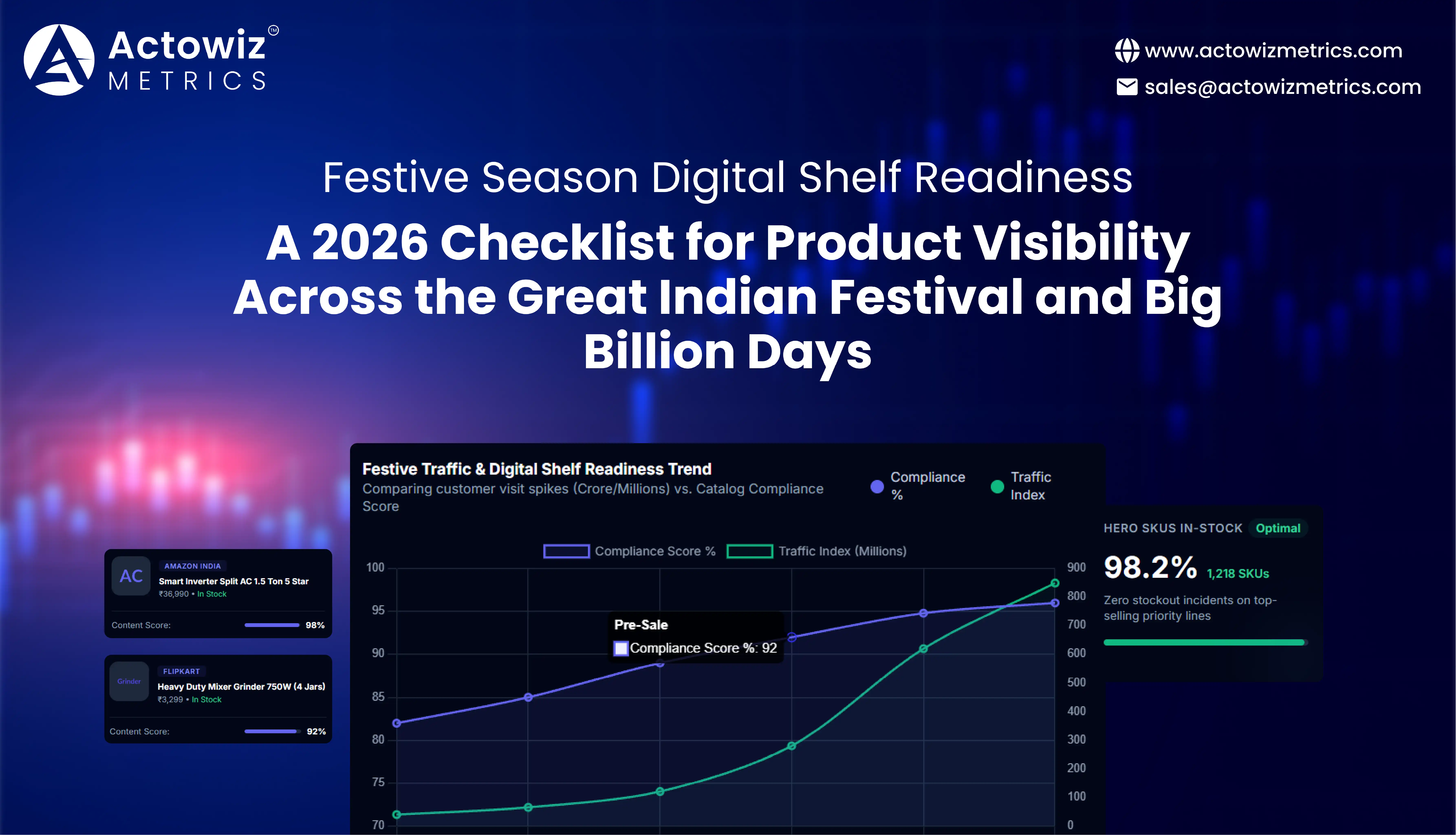
The importance of stock-aware monitoring is reinforced by recent market scale. Amazon reported 276 crore customer visits during its 2025 Great Indian Festival, with 70% of traffic coming from Tier 2 and Tier 3 cities. Amazon's 2025 results For 2026, Financial Express reported strong opening demand across marketplaces, including a rise in Amazon product orders and 6.3 million concurrent users in a minute on Flipkart. Financial Express report Neither traffic nor order growth proves a particular stockout rate; the figures instead underline why brands should monitor availability directly.
Indian Marketplace Festive Price Drop Monitoring should therefore combine price, seller, variant, and availability observations in one record. This helps teams distinguish a true price war from a temporary stock clearance, an unavailable listing, or a shift to a different seller. It also supports smarter inventory allocation: retailers can protect stock for products with strong demand while avoiding unnecessary discounts on items where competitors cannot fulfil comparable orders.
Actowiz Metrics can help brands structure marketplace observations into a repeatable competitive-intelligence workflow. Competitive & Pricing Intelligence For Retailers is most useful when it connects price changes with comparable products, promotion mechanics, seller details, and stock signals rather than treating every listing as an isolated number.
With Indian Marketplace Festive Price Drop Monitoring, brands can focus on the products and competitors that matter most to their commercial goals. A practical programme can include:
A useful implementation begins with a limited group of high-priority SKUs, a clear competitor list, and agreed alert thresholds. Teams can then assess coverage, data freshness, match accuracy, and how often alerts lead to a meaningful business action. Expand the scope once the workflow is reliable. This makes the programme measurable and prevents monitoring from becoming a stream of disconnected price snapshots.
The business outcome should be evaluated through metrics such as price-position compliance, gross margin, promotion efficiency, availability, and the time required to identify a relevant competitor move. These are business measures to track—not guaranteed results of monitoring alone.
Festive pricing works best when brands understand the full competitive offer: the actual selling price, discount conditions, product visibility, seller, and stock availability. Market-wide figures from Amazon India, Flipkart, Myntra, and Redseer show the scale and evolving nature of India's festive e-commerce market, but they cannot replace verified product-level observations. Retailers should use public market data for context and matched SKU data for decisions.
A disciplined Digital Shelf Analytics programme helps teams identify which products need a response, where promotions are genuinely competitive, and when protecting margin is wiser than matching a discount. Combined with Indian Marketplace Festive Price Drop Monitoring, it gives pricing and category teams a clearer view of the market while campaigns are underway.
Ready to make your festive pricing decisions more data-driven? Contact Actowiz Metrics to discuss a marketplace monitoring programme tailored to your products, competitors, and pricing goals!
Expert blogs, research reports and infographics — practical, data-driven reading across e-commerce and quick-commerce.
Most fields are optional — the more you share, the better your sample.
.webp "infographics")
.webp "infographics")