BLOG










India's Diwali shopping season brings together large marketplace campaigns, competitive product offers, and rising demand for festive essentials. Diwali sale 2026 discounts are attracting attention across electronics, fashion, beauty, home products, groceries, and quick-commerce categories. Businesses can use Amazon analytics and Flipkart analytics to compare listed prices, identify competing offers, and evaluate whether promotional prices represent meaningful savings. For Blinkit and Zepto, availability, basket-level promotions, delivery fees, and location-specific pricing are equally important.
This report combines published historical market statistics with reported 2026 campaign information available as of October 12, 2026. Amazon's Great Indian Festival and Flipkart's Big Billion Days have already begun, so the report distinguishes current announcements from forecasts for the remainder of the Diwali shopping period. Quick-commerce promotions can vary by city, delivery zone, account, and time of day; therefore, no single discount rate should be assumed to apply nationwide.
Research methodology: Historical figures are attributed to industry reports or company announcements. Expected category offers are indicative research estimates based on reported campaign patterns, not guaranteed offers. Where a comparable statistic is unavailable, it is marked accordingly rather than estimated as fact.
The scale of India's festive e-commerce market makes competitor monitoring important for retailers, brands, and marketplace sellers. Diwali 2026 festive sale competitor price analysis India should compare the same products across platforms, capture promotional conditions, and measure price changes against a pre-sale baseline. Diwali sale 2026 discounts should not be judged only by headline percentages because bank offers, exchange bonuses, coupons, and membership benefits can change the final payable amount.
RedSeer estimated that India's festive e-commerce market generated approximately ₹1.2 lakh crore in gross merchandise value in 2024, equivalent to about US$14 billion, representing 12% year-on-year growth. It also reported that spending in Tier 2 and smaller cities increased by 13%, while spending per user rose by approximately 5–6%. These figures indicate growing market participation, but they do not directly measure individual product discounts. Source: RedSeer's 2024 festive e-commerce report.
| Year | Published festive-market indicator | What it means for competitor research |
|---|---|---|
| 2020 | Festive e-commerce sales reached about US$8.3 billion, up 65% from 2019, according to RedSeer reporting | Establish historical context for accelerated online shopping |
| 2021 | A comparable full-season figure is not included here | Use original reports with matching time windows before calculating growth |
| 2022 | Comparable full-season value is not included here | Avoid mixing festive-month and first-week measurements |
| 2023 | RedSeer projected approximately ₹90,000 crore in festive-month e-commerce GMV, up 18–20% | Treat this as a forecast, not a final result |
| 2024 | Approximately ₹1.2 lakh crore in festive GMV; 12% year-on-year growth | Provides a published full-season reference |
| 2025 | Early festive reporting showed strong marketplace and quick-commerce activity, but measurement windows differ | Compare only reports using equivalent periods |
| 2026 | Sale events are live; final full-season results are not yet available | Track actual listing prices and publish final findings after the season |
Sources: Business Standard/RedSeer, 2020, RedSeer, 2023, and RedSeer, 2024.
For 2026, businesses should collect product prices before, during, and after major sale periods. A matched product history reveals whether a price reduction is temporary, sustained, or driven by a seller change. Reports should also identify the observation window and distinguish official discounts from effective prices after eligible payment offers.
Quick-commerce platforms compete through fast delivery, local assortment, convenience, and targeted offers rather than only through large headline discounts. Blinkit Zepto product availability and offer tracking should record the displayed price, promotional price, pack size, stock status, delivery fee, minimum basket requirement, and estimated delivery time. Because these platforms operate through local fulfilment areas, the same product may have a different price or availability status across two neighbourhoods.
A useful historical indicator comes from Diwali 2024 reporting: Blinkit, Zepto, and other quick-commerce companies expanded festival-related products and gifting selections, while adding features such as postpaid payments and faster returns for selected categories. In October 2025, Zepto reported more than two million orders per day during Diwali week. Its reported daily order counts included 2.1 million on October 18, 2.37 million on October 19, and 2.13 million on October 20. These are company-reported order figures, not measures of discount depth. Source: Economic Times, 2024 and Business Standard, October 2025..
| Year | Published quick-commerce indicator | Analytical implication |
|---|---|---|
| 2020 | No directly comparable Blinkit–Zepto Diwali offer dataset used here | Avoid estimating historical discounts without records |
| 2021 | Comparable platform-level festive data not established here | Collect archived prices where available |
| 2022 | No consistent two-platform discount series included | Separate orders, GMV, and price metrics |
| 2023 | No directly comparable Diwali offer series included | Use product-level observations for trend analysis |
| 2024 | Platforms expanded festive gifting selections and promotional features | Track gifting products, sweets, décor, and convenience items |
| 2025 | Zepto reported more than 2 million daily orders during Diwali week | Indicates peak-period operational scale, not price reductions |
| 2026 | Live offers depend on local inventory and current platform promotions | Capture location-specific prices and stock status |
The research implication is clear: quick-commerce monitoring needs repeated observations, ideally at comparable times and delivery locations. Analysts should distinguish a product being unavailable from a price increase and should track minimum-order requirements separately from product-level discounts. This makes the comparison more useful for brands assessing both promotional competitiveness and local availability.
Amazon Flipkart festive deal competitor monitoring should focus on exact product matches, comparable offer conditions, and consistent observation times. Diwali sale 2026 discounts may combine platform markdowns, bank-card incentives, exchange bonuses, no-cost EMI, and limited-time deal events. Comparing only the first price visible on a product page can therefore overstate or understate the savings available to a shopper.
Amazon reported that its Great Indian Festival 2025 attracted more than 276 crore visits during the event, with 70% of traffic coming from Tier 2 and Tier 3 cities. The company also reported nearly ₹1,000 crore in customer savings through bank offers, GST benefits, and cashback rewards. These are Amazon's own campaign figures and should be identified as such. Source: About Amazon India.
For 2026, Amazon's published opening-period update reported more than 440 million visits during the early phase, while Flipkart announced a selection of 150 million products for Big Billion Days. These figures describe platform reach and selection, not the number of discounted products or the average discount percentage. Source: Amazon 2026 results and Flipkart's 2026 announcement.
| Year | Amazon / marketplace indicator | How to interpret it |
|---|---|---|
| 2020 | India's festive e-commerce sales reached about US$8.3 billion, up 65% year on year | Overall market growth, not Amazon-only performance |
| 2021 | Comparable Amazon–Flipkart matched-price statistics not included here | Establish a product-level history where records exist |
| 2022 | Comparable matched-product discount series not included here | Avoid inventing marketplace-specific discount averages |
| 2023 | RedSeer projected ₹90,000 crore in festive-month e-commerce GMV | Market forecast, not a final marketplace result |
| 2024 | Festive e-commerce GMV estimated at approximately ₹1.2 lakh crore | Provides wider market context |
| 2025 | Amazon reported 276 crore visits and nearly ₹1,000 crore in customer savings | Company-reported campaign activity |
| 2026 | Amazon reported 440 million early-phase visits; Flipkart announced 150 million products | Current reach and assortment indicators, not discount depth |
A robust comparison should track the same SKU on both platforms, record the seller and timestamp, and calculate the price change from a pre-sale baseline. Conditional offers should appear in separate fields so teams can compare standard selling prices and eligible checkout prices without confusing the two.
Amazon & Flipkart product discount data collection Diwali requires a clear method for identifying products, retaining price histories, and recording the conditions attached to each offer. Product titles alone are not sufficient for matching. Researchers should use brand, model number, storage capacity, size, colour, pack quantity, and other defining attributes to avoid comparing different versions of the same item.
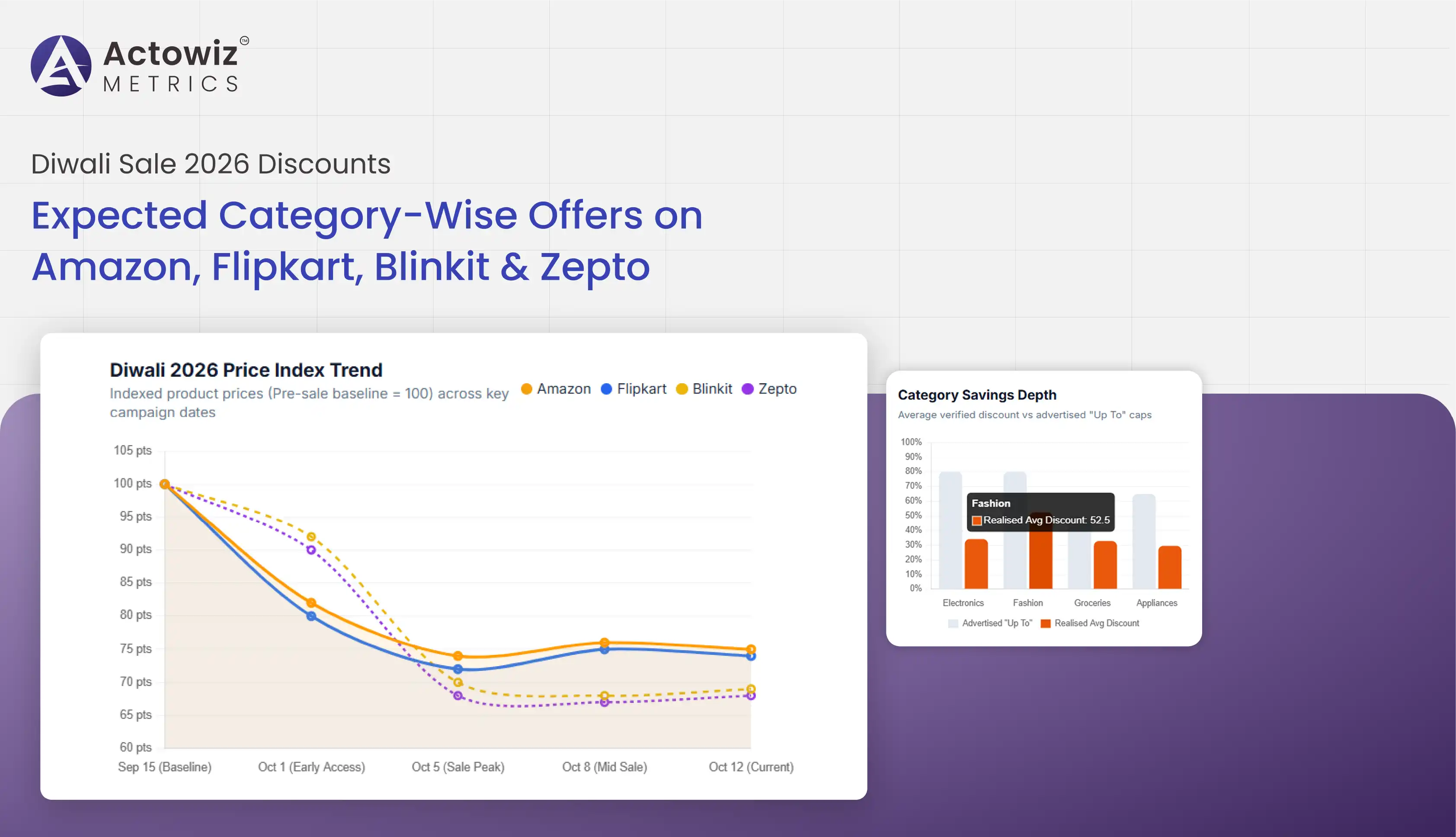
The 2026 campaign environment includes a wide assortment of product types. Flipkart announced 150 million products for Big Billion Days, alongside 1,200-plus fashion trends highlighted for the campaign. Amazon's 2025 campaign preview advertised category-specific maximum discounts, including up to 80% on selected electronics and accessories and up to 65% on selected home appliances. These are advertised "up to" values for eligible selections and should not be treated as average realised savings. Flipkart's 2026 announcement and Amazon's 2025 sale preview.
| Data field | Collection requirement | Why it matters |
|---|---|---|
| Product identifier | Exact SKU, model, or variant | Ensures like-for-like matching |
| Pre-sale price | Repeated dated observations | Establishes the baseline |
| Sale price | Capture at the same observation intervals | Measures observed price change |
| Advertised discount | Preserve the platform's stated claim | Allows comparison with measured changes |
| Bank or payment offer | Record eligibility and terms | Separates conditional savings |
| Exchange or bundle offer | Record separately | Avoids mixing product price with trade-in value |
| Seller and stock status | Save seller and availability | Explains changes that may not be price-driven |
| Timestamp and location | Record date, time, and delivery area where relevant | Supports reproducibility |
The standard calculation is:
Price change (%) = [(Sale price − Pre-sale baseline) ÷ Pre-sale baseline] × 100
For example, a product with a ₹20,000 median pre-sale price and a ₹17,000 observed sale price is 15% below that baseline. This example is illustrative, not a reported Amazon or Flipkart transaction.
Reports should publish the sample size, observation period, product-matching rules, and treatment of coupons. If the baseline price is missing or the product variant changes, the record should be excluded from direct comparisons or clearly marked as incomplete. This creates an auditable dataset instead of relying on headline claims alone.
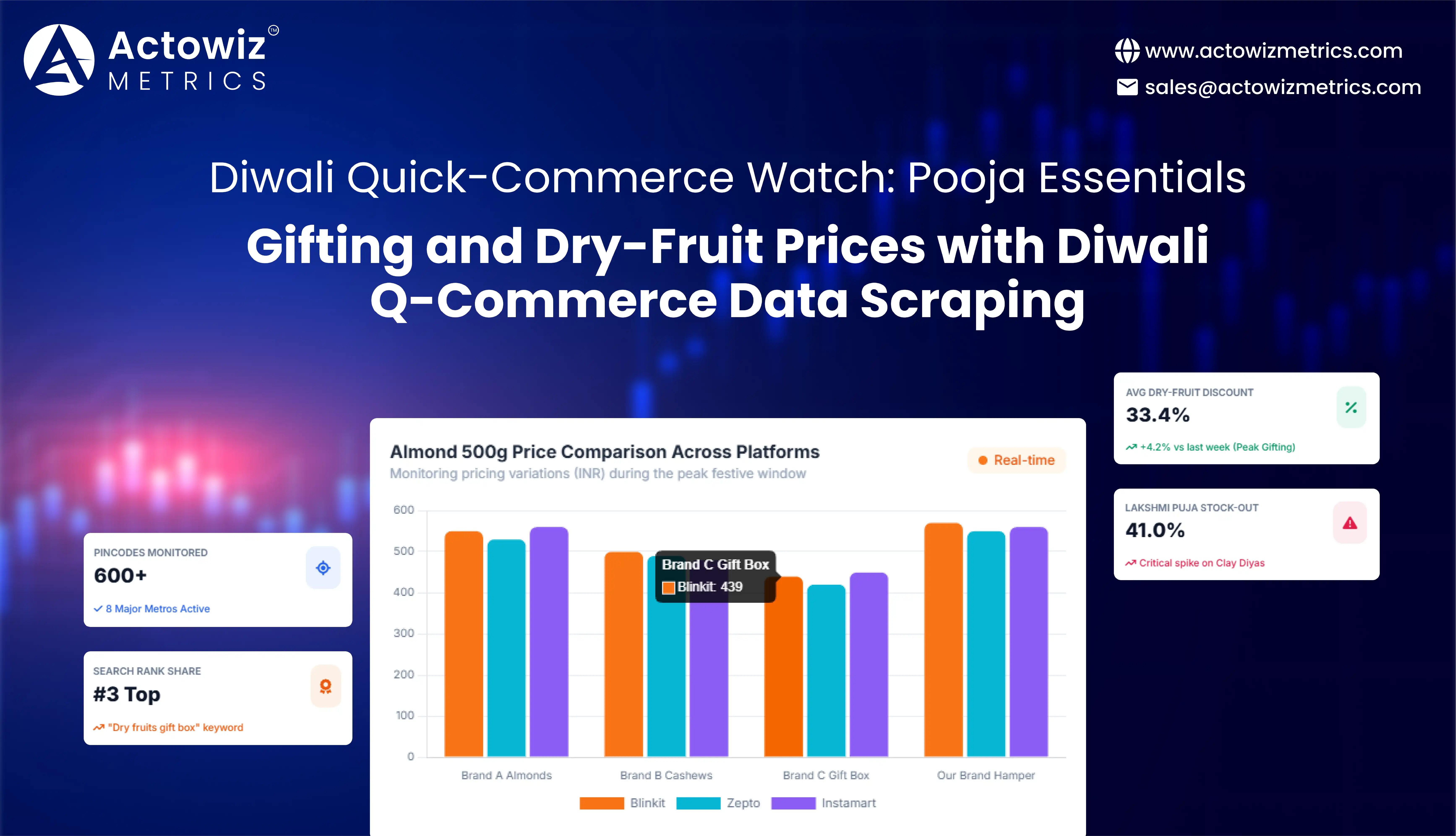
Blinkit & Zepto product price tracking Diwali 2026 should extend beyond individual prices to compare the total cost of a representative festive basket. Relevant products may include sweets, dry fruits, snacks, beverages, cooking oil, flour, cleaning products, personal care, flowers, decorative lights, gift packs, and other seasonal essentials. Pack size and brand must be standardised because a lower price may simply reflect a smaller quantity.
Quick-commerce promotions can include product markdowns, multi-buy offers, wallet cashback, membership benefits, free delivery thresholds, and basket-level coupons. The value of these offers depends on eligibility and availability. For a fair comparison, researchers should calculate both the item-level price and the total basket cost after qualifying discounts and applicable fees.
| Year | Published evidence | Implication for basket tracking |
|---|---|---|
| 2020 | No consistent Blinkit–Zepto festive basket price series used here | Do not infer historical prices |
| 2021 | Comparable basket-level price data not included | Archive product and pack details if available |
| 2022 | No verified common basket benchmark included | Build a standardised list of matching products |
| 2023 | No directly comparable two-platform Diwali basket figure included | Record prices and fees at matched times |
| 2024 | Quick-commerce platforms expanded festive gifting and seasonal selections | Include festive and convenience-led products |
| 2025 | Zepto reported more than 2 million orders per day during Diwali week | Supports the relevance of peak-period monitoring |
| 2026 | Live assortment and offers vary by locality | Capture the same basket in each chosen delivery zone |
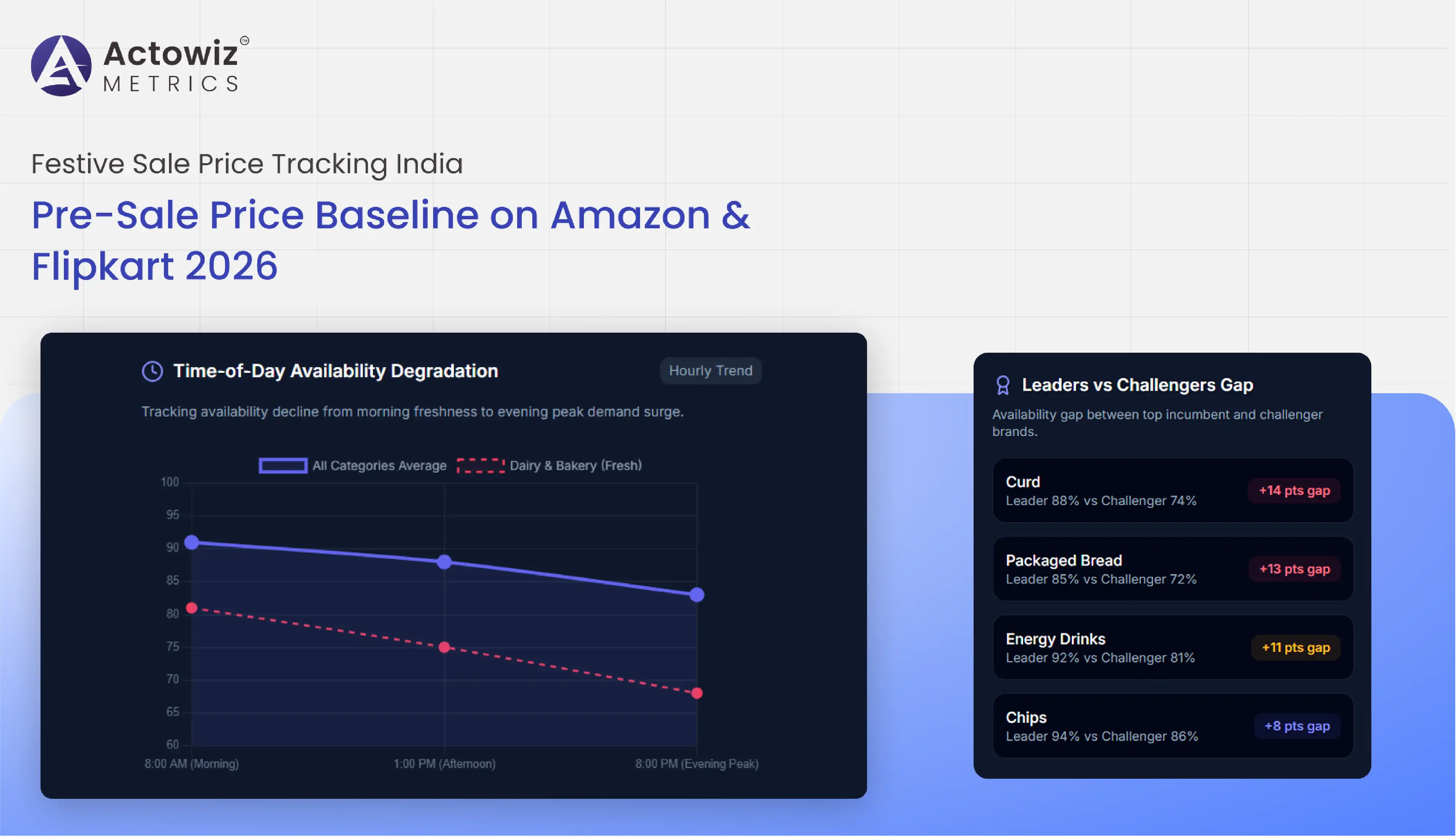
The basket should be captured at fixed times, such as morning, afternoon, and evening, during the pre-sale period and the main campaign. Analysts should record out-of-stock items, substitutions, minimum basket requirements, and delivery charges. A platform that lacks a product should not automatically be treated as more expensive; availability is a separate measure.
The final output can show the cheapest available equivalent basket, percentage of items available on both platforms, average item-price difference, and frequency of offer changes. These metrics reveal whether shoppers receive better value through lower product prices, wider availability, or more favourable basket-level incentives.
Blinkit analytics can help businesses examine product availability, local price changes, basket composition, and promotion timing. Diwali sale 2026 discounts should be assessed with a combination of price history and availability data, particularly when comparing fast-moving essentials with durable products. A large advertised discount may have limited value if the product is frequently out of stock, restricted to selected locations, or available only after meeting a minimum-spend threshold.
The 2024 festive market provides context for this approach. RedSeer estimated that spending per user increased by 5–6% and spending in Tier 2+ cities rose by 13%. Those trends suggest that both affordability and local assortment deserve attention, although neither figure directly proves that quick-commerce discounts increased. Source: RedSeer.
| Metric | Calculation | Business use |
|---|---|---|
| Median price change | Compare sale price with the pre-sale median | Measure actual price movement |
| Offer frequency | Count observations with a valid promotion | Identify recurring promotions |
| Availability rate | In-stock observations ÷ total observations | Measure product availability |
| Matched-basket cost | Sum equivalent products and applicable fees | Compare total customer cost |
| Offer eligibility | Record conditions attached to each promotion | Identify who can access the savings |
| Price volatility | Measure variation over the observation window | Prioritise products needing closer checks |
| Cross-platform price gap | Compare matched products or baskets | Identify relative price positioning |
For 2026, the best approach is to combine a historical reference dataset with current, time-stamped observations. Teams can then distinguish lasting price reductions from short-lived offers and stock-related changes. Quick-commerce data should be captured for defined delivery locations because availability and offers may vary within the same city.
A final research dashboard should present the number of products tracked, percentage with complete price histories, median change by category, and the share of offers that require a payment method or minimum spend. This makes the report actionable for pricing teams, brand managers, and retail analysts while preventing advertised maximum discounts from being mistaken for typical customer savings.
Actowiz Metrics helps businesses structure marketplace research into datasets that support pricing intelligence, promotional evaluation, and competitor analysis. With Zepto analytics, businesses can examine product availability, observed prices, basket-level offers, and local assortment changes alongside other marketplace signals. A structured Diwali sale 2026 discounts study can help brands distinguish headline promotions from measured price changes and identify where competitors are adjusting their offers.
The process can combine historical observations, current product listings, seller information, and timestamped price records into a consistent reporting framework. Researchers can also separate standard prices from conditional offers, identify unavailable products, and compare matched products or baskets across platforms. These insights support better-informed pricing reviews, promotional planning, and festive campaign evaluation.
Diwali promotions span large marketplaces and quick-commerce apps, but the value of an offer depends on the product, reference price, eligibility conditions, and local availability. Historical reports show that India's festive e-commerce market has grown substantially, while recent platform announcements demonstrate the scale of shopping activity and assortment during major sale events. However, visits, orders, GMV, and advertised maximum discounts are different measures and should not be treated as interchangeable.
A reliable Diwali sale 2026 discounts report combines published market statistics with verified product-level observations. By comparing pre-sale baselines, campaign prices, stock availability, and effective basket costs, businesses can evaluate their competitive position with greater confidence.
Ready to strengthen your festive pricing strategy? Contact Actowiz Metrics to discuss a tailored marketplace data solution for Amazon, Flipkart, Blinkit, and Zepto, including price tracking, offer monitoring, and category-level competitor intelligence!
Expert blogs, research reports and infographics — practical, data-driven reading across e-commerce and quick-commerce.
Most fields are optional — the more you share, the better your sample.

.webp "infographics")
.webp "infographics")