BLOG

















A retailer or consumer brand can invest heavily in a data pipeline and still discover that the source does not provide sufficient product coverage, prices are inconsistent, locations are missing, or the collected fields cannot support the intended business decisions.
A Retail data proof of concept addresses this risk by testing the complete workflow on a controlled scope before production deployment.
For example, a retailer planning competitor monitoring may want to collect:
The pilot determines whether these fields can be collected consistently and transformed into analytics-ready records.
This is particularly relevant as India's digital retail market continues to expand. According to the Department for Promotion of Industry and Internal Trade, India's e-commerce market is projected to reach US$350 billion by 2030, up from approximately US$125 billion in 2024.
For category managers, e-commerce teams, pricing teams, market researchers, and data leaders, the objective is therefore not simply to prove that scraping is technically possible. The objective is to prove that the resulting dataset can answer a specific business question and strengthen Competitor intelligence with reliable, actionable retail data.
| Validation area | Question answered |
|---|---|
| Source accessibility | Can the required pages be accessed consistently? |
| Data coverage | Can the required products, categories, and locations be captured? |
| Data quality | Are fields accurate and complete? |
| Refresh frequency | Can data be collected at the required intervals? |
| KPI suitability | Can collected fields calculate business KPIs? |
| Scalability | Can the approach expand beyond the pilot? |
| Delivery format | Can the output integrate with existing analytics systems? |
The most effective pilot therefore starts with business KPIs and works backward toward sources, fields, collection logic, validation, and delivery.
A pilot should establish a measurable baseline before the production build begins.
For instance, a business monitoring 500 products across five competitors might test a smaller product set across representative categories, brands, locations, and page types.
The pilot should answer five core questions:
These questions prevent a common mistake: treating successful extraction from a handful of pages as proof that a complete retail intelligence program will work.
A Retail competitive intelligence data pilot should test whether competitor information can be collected, normalized, and compared consistently.
Competitive monitoring often involves multiple retailers with different:
A pilot should therefore create a common schema.
| Field | Purpose |
|---|---|
| Retailer | Identifies source |
| Product ID | Supports product matching |
| Product name | Product identification |
| Brand | Brand comparison |
| Category | Category benchmarking |
| Price | Price comparison |
| MRP | Discount calculation |
| Promotion | Offer analysis |
| Availability | Stock monitoring |
| Rating | Customer perception |
| Review count | Review-volume comparison |
| URL | Source traceability |
| Timestamp | Historical tracking |
What should the pilot measure? A useful pilot dashboard can include:
| KPI | What it measures |
|---|---|
| Field completeness | Percentage of required fields populated |
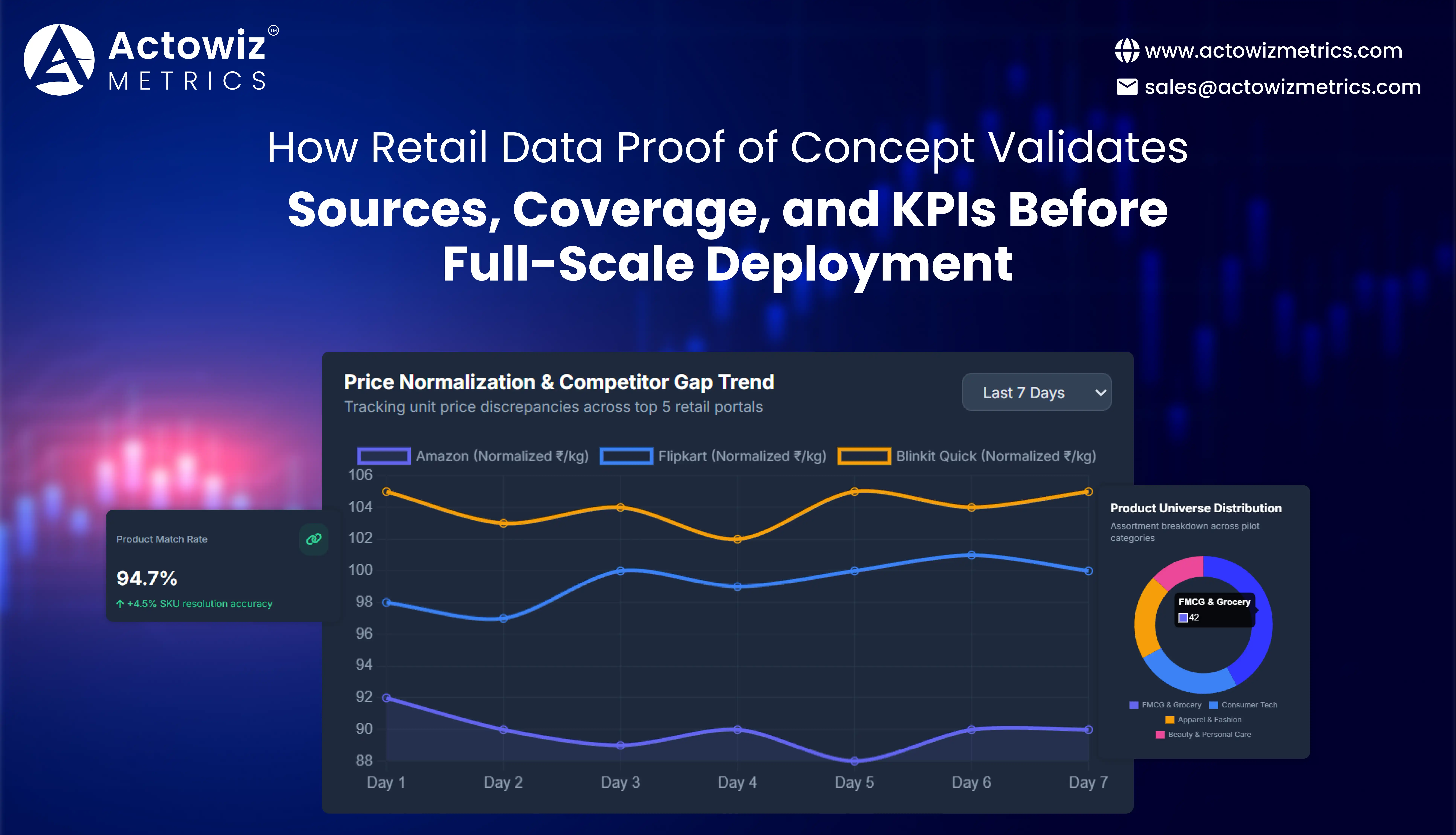
| Product match rate | Ability to match equivalent products |
| Duplicate rate | Data-cleaning requirement |
| Collection success rate | Technical reliability |
| Freshness | Time between collection and delivery |
| Coverage | Share of target assortment captured |
| Validation accuracy | Agreement with source data |
A pilot becomes more valuable when every KPI has an explicit acceptance criterion.
Retail data requirements changed significantly between 2020 and 2026 as online shopping became more integrated with broader retail strategies. During the early 2020s, many businesses focused on basic competitor price collection and product availability. As marketplaces expanded their assortment and retailers developed omnichannel models, the need for structured product, pricing, promotion, and availability datasets increased. India's e-commerce market continued to expand, with industry estimates placing the market at approximately US$125 billion in 2024 and projecting it to reach US$350 billion by 2030. At the same time, quick-commerce networks introduced faster-changing product and availability conditions. Bain reported that India's quick-commerce orders doubled between 2022 and 2023, demonstrating how quickly high-frequency digital commerce can scale. This evolution means a modern pilot needs to test more than extraction. It should establish whether product matching, price normalization, location coverage, timestamping, and recurring collection can support competitive analysis. By 2026, retailers increasingly need a repeatable framework that can move from a small source test to a monitored production pipeline without redesigning the entire data model.
A Retail pricing data pilot implementation should determine whether collected prices are accurate, comparable, and sufficiently fresh for the intended pricing decisions.
Price data can become misleading when retailers use different units, pack sizes, promotions, or membership prices.
For example:
These prices cannot be compared directly without normalization.
What should be tested?
| Pricing element | Validation requirement |
|---|---|
| Selling price | Correct current value |
| MRP | Correct reference value |
| Pack size | Standardized unit |
| Discount | Correctly calculated |
| Promotion | Captured separately |
| Member price | Distinguished from standard price |
| Currency | Standardized |
| Timestamp | Records collection time |
| Product identity | Matches equivalent SKU |
A strong pilot should calculate normalized metrics such as:
Price per unit = Selling price ÷ standardized quantity
This makes products with different package sizes easier to compare.
A price dataset without collection timestamps has limited historical value.
Retail prices can change because of:
Therefore, every price record should retain its observation time.
Pricing intelligence became more dynamic between 2020 and 2026 as online retail and marketplace competition increased. Early retail monitoring programs often focused on periodic price checks. More mature programs increasingly required historical price series, promotional context, product matching, and frequent refreshes. India's e-commerce expansion has increased the commercial importance of these capabilities. IBEF reports that India's e-commerce industry was valued at about US$125 billion in 2024 and is projected to reach US$350 billion by 2030. Meanwhile, the growth of quick commerce introduced substantially shorter buying cycles and more frequent assortment and availability changes. Bain's research reported that quick-commerce orders doubled between 2022 and 2023. For businesses, this means a price pilot should test whether the source can deliver data at the frequency required by the business—not merely whether a price can be extracted once. By 2026, successful pricing pilots should also distinguish standard prices from promotions, normalize package sizes, preserve historical timestamps, and establish rules for identifying equivalent products across retailers.
A Retail product data pilot for analytics, Retail data proof of concept should focus on whether raw retail information can be transformed into a consistent analytical dataset.
The critical issue is usually not collecting a product page. It is making thousands of product records comparable.
Product normalization workflow:
Source page → extraction → cleaning → product matching → normalization → validation → analytics dataset
A pilot can test:
| Dimension | Example analytical use |
|---|---|
| Brand | Brand share |
| Category | Category assortment |
| SKU | Product-level monitoring |
| Pack size | Unit-price comparison |
| Price | Price benchmarking |
| Discount | Promotion measurement |
| Availability | Stock monitoring |
| Rating | Product perception |
| Review count | Engagement signal |
| Retailer | Competitive comparison |
The pilot should also test whether the final dataset can feed:
Retail product data moved from relatively simple catalog collection toward structured product intelligence during 2020–2026. As online assortments expanded, businesses needed to compare products across retailers even when product names, pack sizes, attributes, and categories differed. This created a growing requirement for entity resolution and normalization. The broader Indian e-commerce market has expanded substantially, with projections indicating continued growth through 2030. At the same time, quick commerce has increased the frequency with which assortment and availability can change. Bain reported that quick-commerce orders doubled between 2022 and 2023, reflecting a rapidly scaling environment. A 2026-ready pilot therefore needs to validate the entire product-data lifecycle. It should establish whether a business can reliably identify products, match equivalent SKUs, standardize attributes, calculate comparable prices, and preserve historical observations. This is particularly important for analytics teams because a technically complete dataset can still produce inaccurate insights if product identities are inconsistent. A pilot allows businesses to discover these issues while the dataset is still small enough to correct economically.
A retail data collection pilot project for e-commerce should evaluate the technical and operational reliability of the intended collection process.
The pilot should represent the complexity of the eventual production environment.
That means testing more than one page.
| Test dimension | Pilot coverage |
|---|---|
| Retailers | Multiple representative sources |
| Categories | High- and low-complexity categories |
| Products | Popular and long-tail products |
| Locations | Multiple target locations |
| Page types | Listing and product pages |
| Devices | Relevant rendering environments |
| Refresh | Required production frequency |
| Output | Final delivery format |
The pilot should intentionally include difficult cases.
Examples include:
Testing difficult cases early is more informative than testing only clean product pages.
E-commerce data collection became more technically complex between 2020 and 2026 as retailers introduced dynamic websites, personalization, location-based availability, richer product pages, and rapidly changing catalogs. At the same time, businesses increasingly expected data pipelines to operate continuously rather than as occasional research exercises. India's e-commerce market expansion provides the broader context: industry projections indicate growth from roughly US$125 billion in 2024 toward US$350 billion by 2030. Quick commerce has further increased the importance of freshness because product availability and delivery promises can vary rapidly. Bain's 2023 analysis showed that quick-commerce orders had doubled year over year, demonstrating the speed of market expansion. Consequently, a modern pilot should test collection reliability under realistic conditions, including dynamic pages, pagination, product variants, availability changes, and location-specific information. It should also measure how quickly collected information can reach the final analytics environment. By 2026, the pilot's purpose is to establish whether the workflow can repeatedly deliver the required dataset—not merely demonstrate that a crawler or extraction method can work once.
A retail data pilot scope for web scraping and analytics should be specific enough to produce measurable results and narrow enough to complete without excessive investment.
An effective scope normally defines six elements:
1. Sources
Specify the exact retailer, marketplace, brand, or website.
2. Product universe
Define categories, brands, SKUs, or product URLs.
3. Geography
Specify countries, regions, stores, cities, or pincodes.
4. Data fields
Document every required attribute before development begins.
5. Refresh frequency
Specify hourly, daily, weekly, or event-based collection requirements.
6. Output
Define whether the final dataset will be delivered as CSV, JSON, database tables, API feeds, or another structured format.
| Scope component | Pilot definition |
|---|---|
| Sources | Selected retail websites |
| Categories | Representative priority categories |
| Products | Defined SKU/product sample |
| Geography | Target locations |
| Fields | Product, price, promotion, availability |
| Frequency | Agreed refresh interval |
| Validation | Field and record-level checks |
| Output | Analytics-ready dataset |
| Success criteria | Predefined KPIs |
The key is to scope around a business decision rather than around a technology demonstration.
Instead of:
"Can we scrape this website?"
Ask:
"Can we collect enough accurate product and pricing data from this market to calculate our competitive pricing KPIs every day?"
That question creates a much stronger pilot.
The role of pilots expanded as retail organizations moved from isolated data projects toward enterprise analytics. In the early 2020s, teams could validate a data source with relatively small manual or semi-automated tests. As online assortment, marketplace participation, and digital retail activity grew, data programs increasingly required clear governance, repeatable schemas, monitoring, and scalable infrastructure. India's projected e-commerce expansion toward US$350 billion by 2030 illustrates the increasing volume of commercial data that businesses may need to process. Meanwhile, quick commerce demonstrated how rapidly a digital retail model can scale: Bain reported that quick-commerce orders doubled between 2022 and 2023. These trends make pilot scoping more important, not less. A poorly defined pilot can prove a narrow technical capability without establishing whether the data is useful for production analytics. A well-designed pilot defines the source universe, product universe, geographic coverage, fields, refresh schedule, quality thresholds, delivery format, and success criteria before implementation. This makes the transition from pilot to production more predictable and gives business stakeholders a measurable basis for approving the next phase.
Price & promotion intelligence, Retail data proof of concept can help businesses distinguish genuine price movements from temporary promotional activity.
A simple price tracker may report:
Product A: ₹100 → ₹80
But a promotion-aware system should determine whether:
| Field | Analytical purpose |
|---|---|
| Regular price | Baseline |
| Promotional price | Offer measurement |
| Discount percentage | Promotion intensity |
| Promotion type | Offer classification |
| Start date | Campaign tracking |
| End date | Campaign duration |
| Eligibility | Customer segmentation |
| Pack size | Comparable pricing |
| Availability | Promotion effectiveness |
This enables businesses to distinguish pricing strategy from promotional strategy.
What KPIs can be calculated?
Between 2020 and 2026, digital retail competition increasingly required businesses to monitor not just prices but the context surrounding those prices. As e-commerce expanded, retailers and marketplaces used promotions, discounts, loyalty benefits, coupons, bundles, and event-based campaigns to influence purchasing behavior. India's e-commerce market is projected to grow substantially from its estimated US$125 billion value in 2024 toward US$350 billion by 2030. The rise of quick commerce added another layer because frequent product and promotion changes can occur within shorter shopping cycles. Bain's research showed that quick-commerce orders doubled between 2022 and 2023, highlighting the pace of change in this segment. A pilot in 2026 should therefore test whether promotional metadata can be captured alongside prices and product identities. This prevents businesses from interpreting every observed price difference as a permanent pricing decision. The pilot should also preserve timestamps so analysts can reconstruct when a promotion appeared, how long it lasted, and whether competing retailers changed their prices during the same period. Such historical context makes the resulting dataset considerably more useful for category managers and pricing teams.
Actowiz Metrics can help businesses design and execute a controlled pilot before moving to full-scale retail data collection.
The process can be structured around four stages.
1. Define the business question
The first step is identifying the decision the dataset needs to support.
Examples:
2. Define the data model
Actowiz Metrics can structure the required fields around the business use case.
A typical model can include:
Product → Brand → Category → Retailer → Location → Price → Promotion → Availability → Timestamp
3. Execute the pilot
The pilot can test representative:
4. Validate the results
Validation can cover:
Availability & assortment tracking
Availability & assortment tracking can be included when businesses need to understand which products are listed, unavailable, newly introduced, discontinued, or selectively offered across locations.
This is particularly useful for:
The pilot can establish whether availability and assortment information is sufficiently reliable to support recurring monitoring.
What does the final pilot report contain?
A useful pilot report should document:
| Output | Purpose |
|---|---|
| Sources tested | Confirms source feasibility |
| Fields captured | Confirms data scope |
| Coverage results | Identifies gaps |
| Quality results | Measures accuracy |
| Refresh results | Tests frequency |
| Exceptions | Documents limitations |
| KPI calculations | Proves analytical value |
| Recommendations | Defines production next steps |
The outcome should be a clear go, refine, or stop decision based on measurable evidence.
Before approving a full-scale deployment, business and data teams should be able to answer:
Can the required sources be accessed reliably?
If not, the production design needs another approach.
Is the required assortment covered?
A dataset containing only popular products may not represent the complete category.
Are products matched correctly?
Incorrect SKU matching can distort competitive comparisons.
Are prices normalized?
Different pack sizes and promotional structures need consistent treatment.
Is the refresh rate sufficient?
Daily data is not appropriate for every business problem.
Can the data calculate the required KPIs?
If the dataset cannot support the intended decision, more extraction will not solve the problem.
Can the workflow scale?
The pilot should identify technical bottlenecks before production.
Can stakeholders consume the output?
A technically accurate dataset still has limited business value if it cannot reach the team's dashboard, warehouse, API, or reporting system.
A retail data project should not begin with a large-scale commitment. It should begin with evidence.
A properly designed Retail data proof of concept can establish whether sources are accessible, products are sufficiently covered, fields are accurate, prices are comparable, availability can be tracked, and business KPIs can actually be calculated.
The 2020–2026 expansion of digital commerce has increased both the volume and complexity of retail data. India's e-commerce market is projected to reach US$350 billion by 2030, while quick commerce has demonstrated how quickly digital retail models can scale.
For retailers, brands, category managers, pricing teams, and data leaders, the strongest approach is to test the complete data lifecycle:
Business question → source → collection → normalization → validation → KPI → delivery → scale
This approach reduces the risk of building a technically impressive dataset that does not answer the business question.
It also creates a measurable bridge between experimentation and production.
Ready to validate your retail data strategy before investing in full-scale deployment? Partner with Actowiz Metrics to scope a focused Retail data proof of concept, test source coverage and data quality, validate KPIs, and build a production-ready path for retail intelligence!
Expert blogs, research reports and infographics — practical, data-driven reading across e-commerce and quick-commerce.
Most fields are optional — the more you share, the better your sample.

.webp "infographics")
.webp "infographics")