BLOG


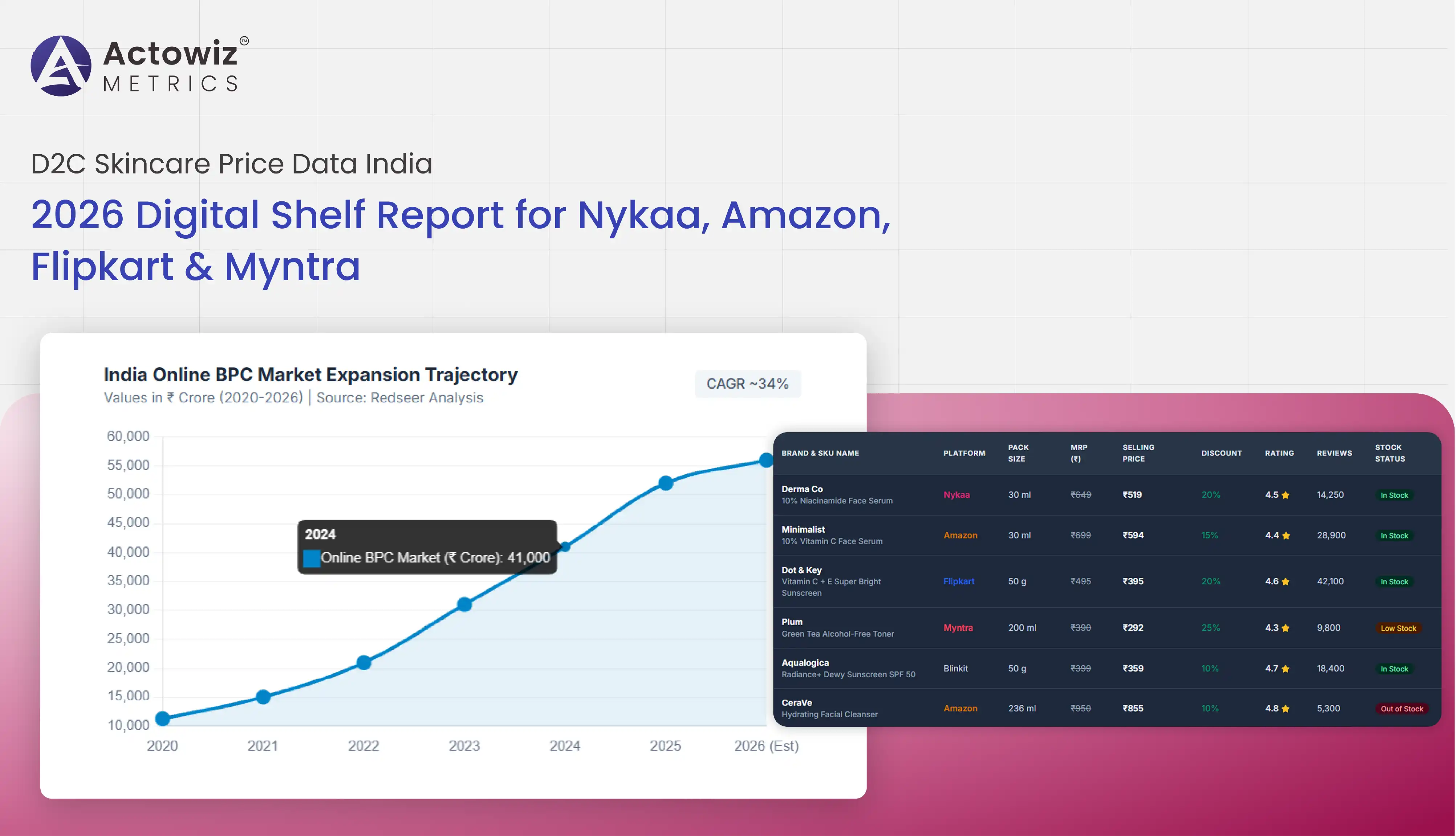
D2C skincare price data India is becoming increasingly important for brands competing across marketplaces because pricing, discounts, availability, ratings, and assortment can change rapidly. Amazon analytics helps brands interpret these marketplace signals alongside broader channel movements and identify where pricing or visibility needs attention. India's online beauty and personal-care market reached about ₹56,000 crore in 2026, growing roughly 35% year over year, while quick commerce has also expanded its role in routine-led beauty purchases. Redseer Strategy Consultants
For D2C skincare brands, the challenge is no longer simply knowing the listed MRP. Teams need to understand the effective selling price, promotional depth, seller variation, ratings, review volume, stock status, pack size, and competitive positioning across major digital shelves. This report examines the evidence available for 2020–2026, with emphasis on marketplace dynamics, pricing intelligence, consumer signals, availability, and practical digital-shelf monitoring.
The India D2C skincare digital shelf analytics 2026 landscape reflects a much larger and more competitive online beauty market than the one visible at the beginning of the decade. Public evidence shows that online BPC expanded from approximately ₹21,000 crore in CY2022 to around ₹52,000 crore in CY2025, representing a 2.4× increase in three years. Redseer reported another major milestone in 2026, with online BPC reaching approximately ₹56,000 crore and growing around 35% YoY. Redseer Strategy Consultants
The earlier market trajectory also provides useful context. A RedSeer report submitted in Nykaa's IPO documentation estimated India's BPC market at ₹1,120 billion in 2020 and projected ₹1,981 billion for 2025. This was a total BPC opportunity rather than an online-only figure, so it should not be compared directly with later online-market estimates. Securities and Exchange Board of India
| Year | Verified market indicator | What it means for digital shelves |
|---|---|---|
| 2020 | ₹1,120 bn estimated India BPC market | Large offline-led opportunity |
| 2021 | No comparable public online-BPC figure identified | Marketplace monitoring increasingly relevant |
| 2022 | ~₹21,000 crore online BPC | Online channel establishes measurable scale |
| 2023 | No comparable public annual figure identified | Channel growth continued |
| 2024 | Online beauty/quick-commerce sales +39% Jun-Nov YoY | Online market more than doubled vs CY22 |
| 2025 | ~₹52,000 crore online BPC | Competition increasingly depends on digital execution |
| 2026 | ~₹56,000 crore online BPC; ~35% YoY growth | Digital shelves now central to category competition |
2024 NielsenIQ data reported by The Economic Times is particularly relevant: beauty e-commerce and quick-commerce sales increased 39% in value from June to November 2024 compared with the same period in 2023, while physical-store sales increased 3%. The Economic Times
For skincare brands, this growth creates a practical monitoring requirement. A product can remain competitively positioned in its own D2C store while appearing expensive on a marketplace because of seller pricing, missing promotions, or an outdated product page. Digital-shelf analysis therefore needs to compare the same SKU, pack size, seller condition, discount state, and availability status rather than relying on headline MRP alone.
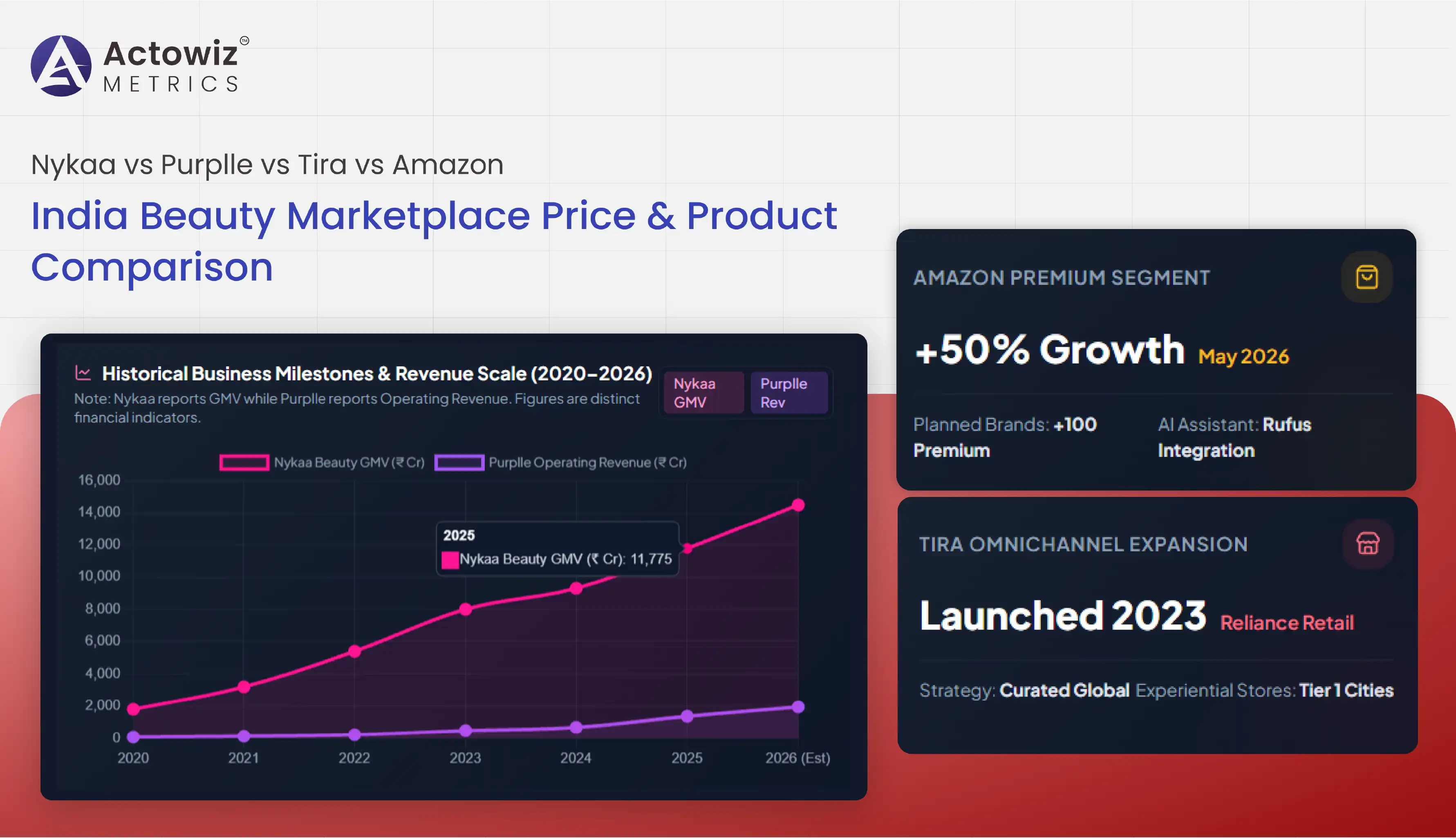
Nykaa, Amazon, Flipkart & myntra skincare price intelligence requires a channel-specific approach because these platforms have different assortments, audiences, merchandising environments, and promotional mechanisms. Nykaa remains especially important in beauty: its FY2025 report recorded ₹11,775 crore in Beauty GMV, up 30% from ₹9,055 crore in FY2024. Beauty represented 75% of Nykaa's consolidated GMV in FY2025. Nykaa
Amazon is expanding its premium beauty assortment aggressively. In 2026, Amazon India announced more than 100 premium beauty brands entering the platform, including skincare names such as La Roche-Posay, CeraVe, Avène, Eucerin, and Paula's Choice. Amazon also states that its Rufus assistant can help shoppers compare ingredient information and review 30-90 days of price history. About Amazon India
Flipkart provides another significant data point. Its 2025 beauty trends announcement, produced with NielsenIQ, stated that more than 148 million beauty products were sold on Flipkart during 2024, with more than five beauty essentials sold every second across haircare, makeup, and skincare. Flipkart Stories
Myntra should be assessed differently because its core positioning is fashion-led, although beauty is part of its broader lifestyle ecosystem. The important analytical principle is not to assume identical category behaviour across platforms.
| Marketplace | Verified public indicator | Monitoring implication |
|---|---|---|
| Nykaa | ₹11,775 crore Beauty GMV, FY2025 | Strong beauty-focused benchmark |
| Amazon | 100+ premium beauty brands announced for 2026 | Premium assortment and price competition expanding |
| Flipkart | 148m+ beauty products sold in 2024 | Large-scale marketplace demand signal |
| Myntra | Fashion-led marketplace with beauty/lifestyle assortment | Compare beauty positioning separately from fashion |
For brands, the useful dataset should standardize product title, SKU, brand, category, pack size, MRP, selling price, discount, seller, rating, review count, availability, and timestamp. This allows analysts to distinguish a genuine price move from a variation caused by pack size or seller-level merchandising.
Nykaa, Amazon, Flipkart & myntra skincare ratings analysis becomes valuable when brands move beyond price tracking and evaluate how consumers respond to products. Ratings can indicate perceived product satisfaction, while review counts provide an additional measure of how much consumer feedback has accumulated. Neither should be interpreted in isolation.
The wider market shows that consumer behaviour is becoming increasingly ingredient- and routine-driven. Redseer reported that face creams and serums and face cleansers each account for roughly 10-15% of overall online BPC, while both categories were growing around 30-35% YoY in FY2026. Redseer Strategy Consultants
| Indicator | Verified evidence | Analytical use |
|---|---|---|
| Online BPC, CY2022 | ~₹21,000 crore | Baseline for digital expansion |
| Online BPC, CY2025 | ~₹52,000 crore | 2.4× CY22 scale |
| Online BPC, FY2026 | ~₹56,000 crore | ~35% YoY growth |
| Face creams & serums | ~10–15% of online BPC each | Major skincare demand pools |
| Face cleansers | ~10–15% of online BPC | Important routine category |
| Flipkart beauty sales, 2024 | 148m+ products | Scale of marketplace activity |
The rating dataset should ideally preserve rating value, review count, rating distribution, review velocity, and timestamp. A product with 4.7 stars from a large review base represents a different competitive signal from a recently launched product with a similar score but very few reviews.
D2C skincare price data India can become considerably more actionable when combined with these consumer signals. For example, brands can identify products that maintain strong ratings while competitors reduce prices, or products where discounting fails to improve consumer response. This helps separate price-sensitive categories from products where ingredients, formulation claims, brand trust, or reviews may have greater influence.
The objective should not be to chase the lowest competitor price. Instead, brands should identify the relationship between price position, promotional intensity, consumer feedback, and availability.
Monitor competitor skincare discounts and promotional pricing in India by recording the complete price context rather than capturing only the percentage discount shown on a product page. Marketplace promotions can involve reduced selling prices, coupons, bank offers, seller-specific reductions, bundles, or other mechanisms that make the final customer price different from the displayed list price.
Public market evidence demonstrates why promotional monitoring matters. Amazon reported that during its 2026 Great Indian Festival, premium skin and hair care sold more than 150 products per minute, five times a normal day, while K-beauty products sold at four times their everyday sales rate. About Amazon India
| Period / event | Verified promotional or demand signal |
|---|---|
| Jun-Nov 2024 | Beauty e-commerce & quick-commerce value +39% YoY |
| CY2024 Flipkart | 148m+ beauty products sold |
| FY2025 Nykaa | Beauty GMV ₹11,775 crore |
| Amazon GIF 2026 | Premium skin/hair care >150 products/minute |
| Amazon GIF 2026 | Premium skin/hair care sales 5× normal day |
| Amazon GIF 2026 | K-beauty sales 4× everyday level |
A useful monitoring framework should therefore capture MRP → displayed price → coupon/offer → effective price, together with the timestamp and seller. Analysts can then calculate promotional depth and determine whether a price change is temporary or persistent.
Seasonality also matters. A festival promotion should not automatically be treated as the new market price. Likewise, a competitor's coupon may be available only to selected customers and should not be interpreted as an equivalent across-the-board price reduction.
For D2C brands, the strongest application is exception-based monitoring. Teams can define thresholds for unusually large price gaps, sudden promotional changes, disappearing discounts, or competitor products entering a predefined price band. This reduces the need for analysts to manually inspect thousands of product pages every day.
The result is a more defensible pricing process: brands can identify meaningful competitive movements while avoiding unnecessary reactions to short-lived promotional noise.
India skincare e-commerce product availability monitoring is essential because an attractive price has limited commercial value when the product cannot be purchased. Stock status, seller availability, delivery eligibility, and geographic coverage can materially change the shopper experience.
| Year | Verified availability/channel indicator |
|---|---|
| 2020 | Digital BPC opportunity was still smaller than today's online ecosystem |
| 2021 | No comparable public availability dataset identified |
| 2022 | Quick commerce ~2% of online BPC |
| 2023 | No comparable public annual share identified |
| 2024 | Beauty e-commerce and quick-commerce sales +39% Jun-Nov YoY |
| 2025 | Quick commerce ~16% of online BPC |
| 2026 | Quick commerce ~18% of online BPC in FY26 |
The figures show a major channel transition, but they should not be interpreted as evidence that every skincare SKU performs better through quick commerce. The category-level trend supports the need to monitor where consumers can actually find routine products.
For a skincare brand, availability monitoring can include SKU status, seller presence, delivery availability by pincode, estimated delivery date where publicly displayed, and whether the preferred seller has disappeared. A sudden loss of availability alongside unchanged demand signals can be more important than a small competitor price movement.
D2C skincare price data India therefore becomes more valuable when connected with availability history. A dashboard can distinguish four commercially different situations: product available at a competitive price, available but overpriced, competitively priced but unavailable, and unavailable across multiple channels.
That distinction helps category managers prioritize actions. Pricing teams can focus on price gaps, marketplace teams can address listing or seller issues, and supply teams can investigate recurring stock interruptions.
Nykaa analytics should not be limited to tracking one platform. Its strongest value comes from establishing a consistent measurement framework that connects marketplace pricing, assortment, demand signals, ratings, promotions, and availability.
Nykaa's FY2025 results illustrate the scale of the beauty ecosystem. The company reported ₹15,604 crore consolidated GMV, including ₹11,775 crore from Beauty, and a cumulative customer base exceeding 42 million across the business. Nykaa
At the wider market level, Redseer estimates that India's BPC market could reach $40 billion by 2030, with online marketplaces and quick commerce reducing traditional geographic and logistical constraints. Redseer Strategy Consultants
A practical executive dashboard should therefore answer five questions:
| Metric | Recommended business decision |
|---|---|
| Effective selling price | Adjust price architecture |
| Discount depth | Evaluate promotional competitiveness |
| Rating/review movement | Identify consumer-response changes |
| Stock/availability | Escalate supply or seller issues |
| SKU assortment | Detect emerging competitors |
| Cross-marketplace gap | Align channel strategy |
This framework also supports Flipkart analytics by creating the same standardized SKU-level structure across platforms. The benefit is comparability: teams can assess whether a competitor is genuinely cheaper or simply selling a different pack, whether a discount is platform-wide or seller-specific, and whether an availability problem is isolated to one marketplace.
For data teams, the collection layer should preserve timestamps and source-page context. For commercial teams, the output should be exception-led rather than an overwhelming raw-data dump. The goal is to transform marketplace observations into decisions that pricing, category, supply, and marketing teams can act on.
Actowiz Metrics can support brands that need a structured approach to marketplace intelligence rather than disconnected screenshots or manually maintained spreadsheets. The value lies in building a repeatable dataset around the commercial attributes that matter: SKU identity, product name, brand, pack size, MRP, selling price, discounts, seller, ratings, reviews, availability, and collection timestamp.
For brands managing multiple channels, this structure makes cross-marketplace comparison easier and helps separate genuine market changes from page-level inconsistencies. It can also support Myntra Fashion Products data scraping workflows when brands need structured marketplace data beyond beauty, subject to applicable platform terms, access permissions, and data-use requirements.
The broader market makes this capability increasingly relevant. India's online BPC market has grown sharply, while quick commerce is taking a larger share of digital beauty spending. Redseer Strategy Consultants
Actowiz Metrics can help teams organize this information into monitoring workflows designed around their specific business questions, including:
The emphasis should remain on data quality, consistent product matching, timestamped observations, and actionable exceptions rather than simply collecting the largest possible volume of records.
India's digital beauty market has moved from an emerging channel to a major commercial environment. Online BPC grew from approximately ₹21,000 crore in CY2022 to ₹52,000 crore in CY2025, while Redseer reported approximately ₹56,000 crore in 2026. Redseer Strategy Consultants Nykaa's FY2025 Beauty GMV reached ₹11,775 crore, Flipkart reported more than 148 million beauty products sold in 2024, and Amazon continues to expand its premium beauty assortment. Nykaa
The implication for D2C skincare brands is clear: marketplace competitiveness cannot be measured through MRP or headline discounts alone. Brands need a structured view of effective price, promotion, seller, ratings, reviews, assortment, and availability across the digital shelf.
The most effective 2026 strategy is to combine these signals into a continuously updated competitive dataset, then use exception-based analysis to identify the changes that actually require commercial action.
Ready to build a reliable digital-shelf intelligence workflow for your skincare brand? Contact Actowiz Metrics to discuss marketplace price, promotion, availability, ratings, and competitive monitoring requirements!
Expert blogs, research reports and infographics — practical, data-driven reading across e-commerce and quick-commerce.
Most fields are optional — the more you share, the better your sample.
.webp "infographics")
.webp "infographics")